Paramount's founding director went from a barn to the Red Sea
Cecil B. DeMille made his first film in a Hollywood barn and later parted the Red Sea. Relay has 19 of his films.
By Relay, Filmmaker Spotlight · Monday, November 16, 2026 · 3 min read
Cecil B. DeMille was a Hollywood director and producer who helped start the company that became Paramount, and he did it from a rented barn. His first film, The Squaw Man, was shot there in 1914 and is usually described as the first feature-length film made in Hollywood. Nine years later he built an Egyptian city in the California dunes and parted the Red Sea.
Between those two points sits most of what people mean by "Hollywood": the studio, the star, the spectacle. DeMille made 70 features between 1914 and 1956, and his estate says all but seven made money. EBSCO's history reference puts it simply: critics never gave him the praise they gave D. W. Griffith, the pioneer of film storytelling, yet "he shaped film history." Relay has 19 of his films.
Who was Cecil B. DeMille?
He was born in Ashfield, Massachusetts, in 1881. In July 1913 he formed the Jesse L. Lasky Feature Play Company with Jesse L. Lasky, whose name it carried, and Samuel Goldwyn, then still called Samuel Goldfish. In 1916 the company joined the firms that became Paramount, and TCM calls the barn the seed from which Paramount grew.
In 1927 he was one of the 36 founders of the Academy of Motion Picture Arts and Sciences, the body that gives the Oscars. His circus film The Greatest Show on Earth later won Best Picture. He was once remembered as the "bathtub king," for the bath scenes in his films. Today he is better known for crowds and epics.
What are his films on Relay?
The Cheat (1915)
A rich young wife gambles away money she collected for the Red Cross and secretly borrows the sum from a wealthy ivory dealer. The film cost about $17,000 and made Sessue Hayakawa, a Japanese actor, a star in the US and France. It joined the National Film Registry, the Library of Congress list of American films kept for preservation, in 1993.
The Japanese American newspaper Rafu Shimpo protested the film, and for the 1918 re-release the villain was changed from Japanese to Burmese.
Joan the Woman (1916)
DeMille's first large historical epic starred Geraldine Farrar, a soprano from the Metropolitan Opera, as Joan of Arc. It cost more than $300,000, his most expensive film to that point, and its flames at the stake were tinted with a new color process.
Male and Female (1919) and Why Change Your Wife? (1920)
In Male and Female, from J. M. Barrie's 1902 play The Admirable Crichton, a butler takes charge of his shipwrecked employers on an island. Gloria Swanson, the star of these films, posed with a live lion for its Babylon dream scene. It cost about $169,000 and earned about $1.26 million.
Why Change Your Wife? opens with a married couple bickering in their bathroom, a scene rare on screen at the time. Critics have traced a line from these marriage comedies to Ernst Lubitsch, the director of sophisticated comedies, and to screwball comedy. They made Swanson one of Hollywood's highest-paid stars, with the leverage to leave Paramount in 1926 and produce her own films.
The Ten Commandments (1923)
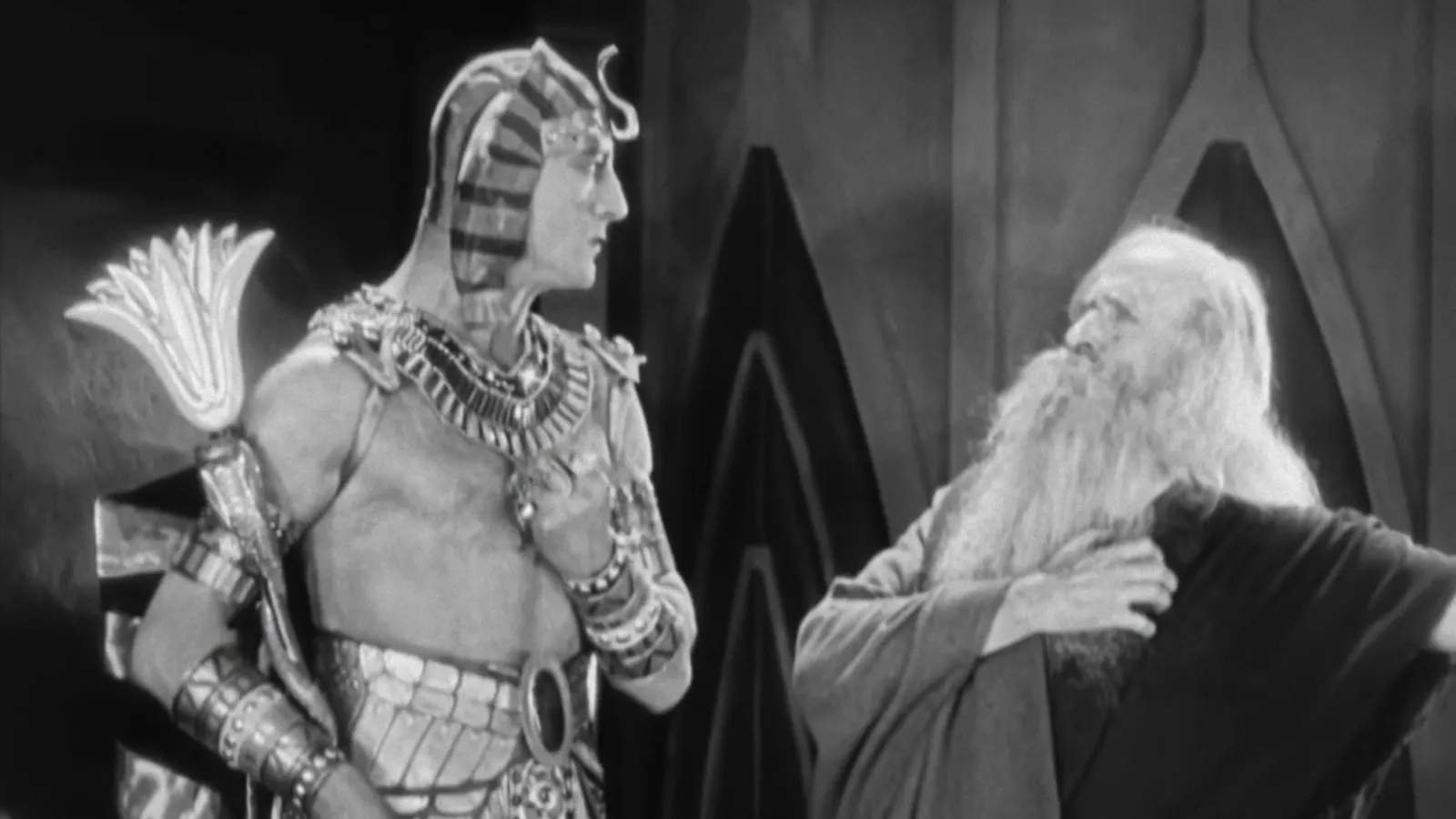
The first half tells the Exodus story; the second follows two brothers in 1920s San Francisco, one of whom breaks the commandments. DeMille built the city of the Pharaoh in the Guadalupe-Nipomo Dunes and left it buried in the sand. In 2012 a team of archaeologists dug up pieces, now shown at the Dunes Center in Guadalupe, California.
It cost about $1.5 million and earned more than $4 million on first release. The Film Foundation says it stayed Paramount's biggest earner for 25 years. DeMille remade it in 1956 with Charlton Heston.
The Ten Commandments
Cecil B. DeMille · 1923 · 136 min
What to watch first
Start with The Cheat, which is in the National Film Registry, then The Ten Commandments for the scale he became known for. Male and Female shows the Swanson films that sold 1920s audiences on fashion.