Movie Spotlight: Ask Delphi
Director Gabriel Rhenals on the formative experience that sparked Ask Delphi, what Excalibur has to do with AI, and why he threw out continuity editing entirely.
By Relay · Friday, May 22, 2026 · 3 min read
The premise sounds like something assembled from headlines: a near-future, a simulator capable of generating feature-length films from a single prompt, and female empowerment. But Ask Delphi did not start with any of that. Director Gabriel Rhenals traces the film back to something smaller and more personal, an experience with his father during adolescence that he describes as formative and “functionally enabling.” The technology came later, because the accelerationist framing was, he says, “irresistible.”
This is his fourth feature. He knows what he is doing and he knows why. Whether that makes Ask Delphi easier or harder to place is part of what makes it worth watching.
Why a Mother and a Daughter
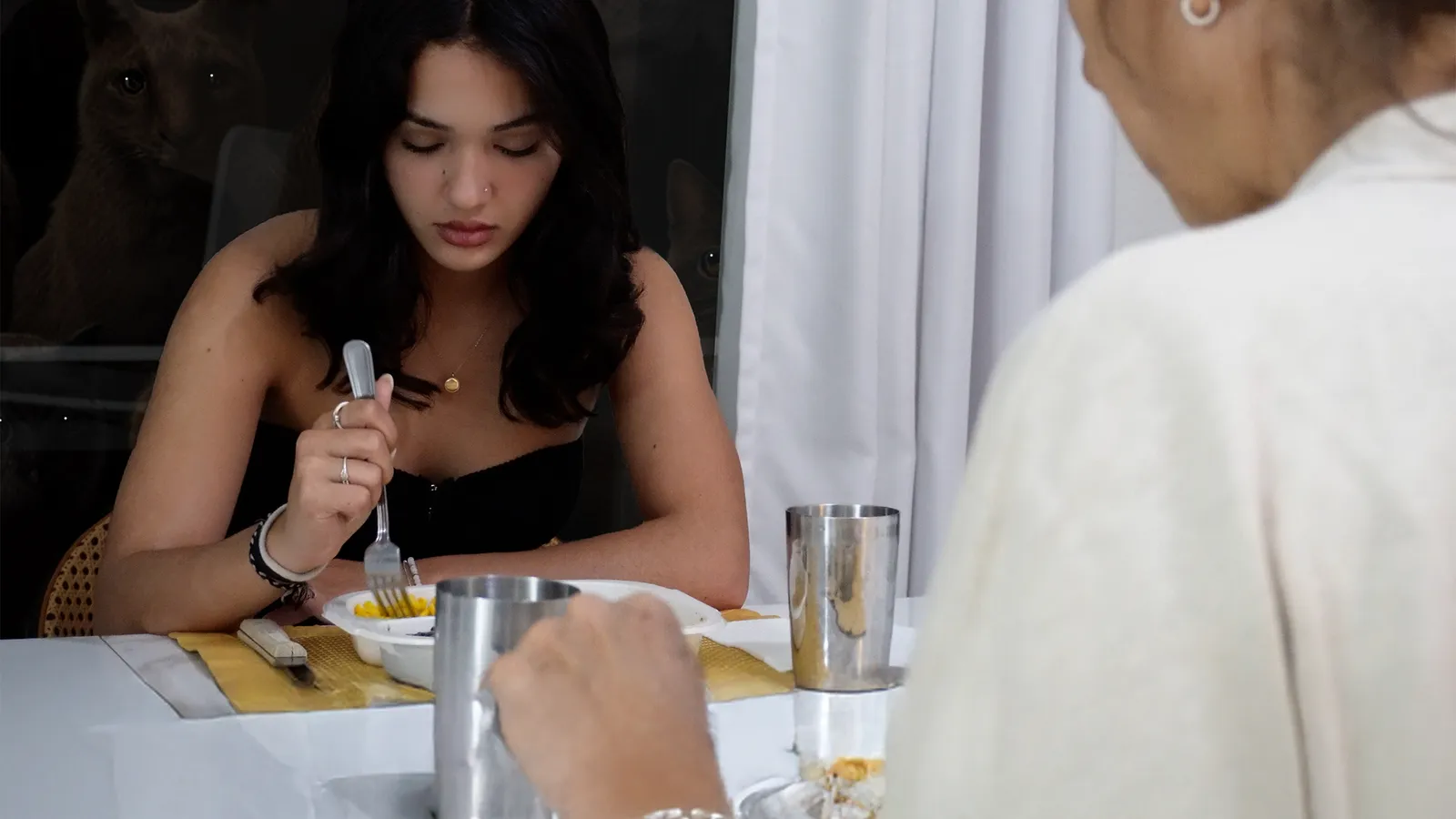
Rhenals was looking for a change of register. Patriarchy and androcentrism, as he puts it, are “done to death.” He wanted to go the other direction, into matriarchy and gynocentrism, more so than he has attempted in his past work. Alma, the matriarch at the center of the film, is not a softened or symbolic figure. She pursues her goal, building a powerful tool for her wayward daughter Zooey, with what Rhenals calls a “singularly steadfast manner.” The emotional analogy he reaches for is Excalibur. The tool Alma tries to forge carries the weight of a Arthurian promise, something made specifically for one person, something that could only be given by someone who understood them completely.
What Delphi Means
The title is an allusion to the Oracle at Delphi, the legendary prognosticating institution of Greek antiquity, and Rhenals says the evocation was intentional. Ancient wisdom, reprocessed through technology. The fictional simulator in the film is called Delphi, and it is capable of generating hours-long, indie-film-like content from a simple user prompt. That part, Rhenals notes, is not as far-fetched as it sounds. “We’re not too far from that reality,” he says. The film is set in an alternate future, but the gap between that future and the present keeps narrowing.
Four Films In
Rhenals describes himself as a dedicated montagist in the Eisensteinian sense, someone who has spent decades learning how to hold a plurality of images, tones, and ideas in productive tension. Ask Delphi let him take that further. He dispensed with continuity editing entirely, what he calls a “tiringly prosaic and overbearing preoccupation with matching action from shot to shot.” The result is a film that moves by its own logic. The sci-fi elements, the comedy, the family drama, the speculation, none of it is smoothed into genre. They coexist the way ideas coexist when someone is actually thinking.
The cast is large for a story this contained: Alma, Zooey, Lo, Mr. Dermatax, co-workers, students, sellers, and something credited as Al’s Computer. Rhenals is comfortable with this. Arranging numerous characters in an orderly manner that supports theme and generates necessary effects is, he says, “a familiar writerly and directorial flex.” The technological framing device, he notes, only surfaces at a few junctures. Most of the film is relational, giving Alma, Zooey, and the other principals room to move.
What to Know Before You Press Play
Rhenals wants viewers to know that Ask Delphi is, at its core, a simple story. Parenthood, youthful romance, technology. But it arrives in a form that sets it apart from most of what surrounds it. “It possesses some distinctive formal features,” he says, “that make it rather unique in a mediascape saturated with formal sameness.” That is a fair warning. This is not a film that moves like other films.
Ask Delphi
Gabriel Rhenals · 2025 · 75 min
Streaming now on Relay.