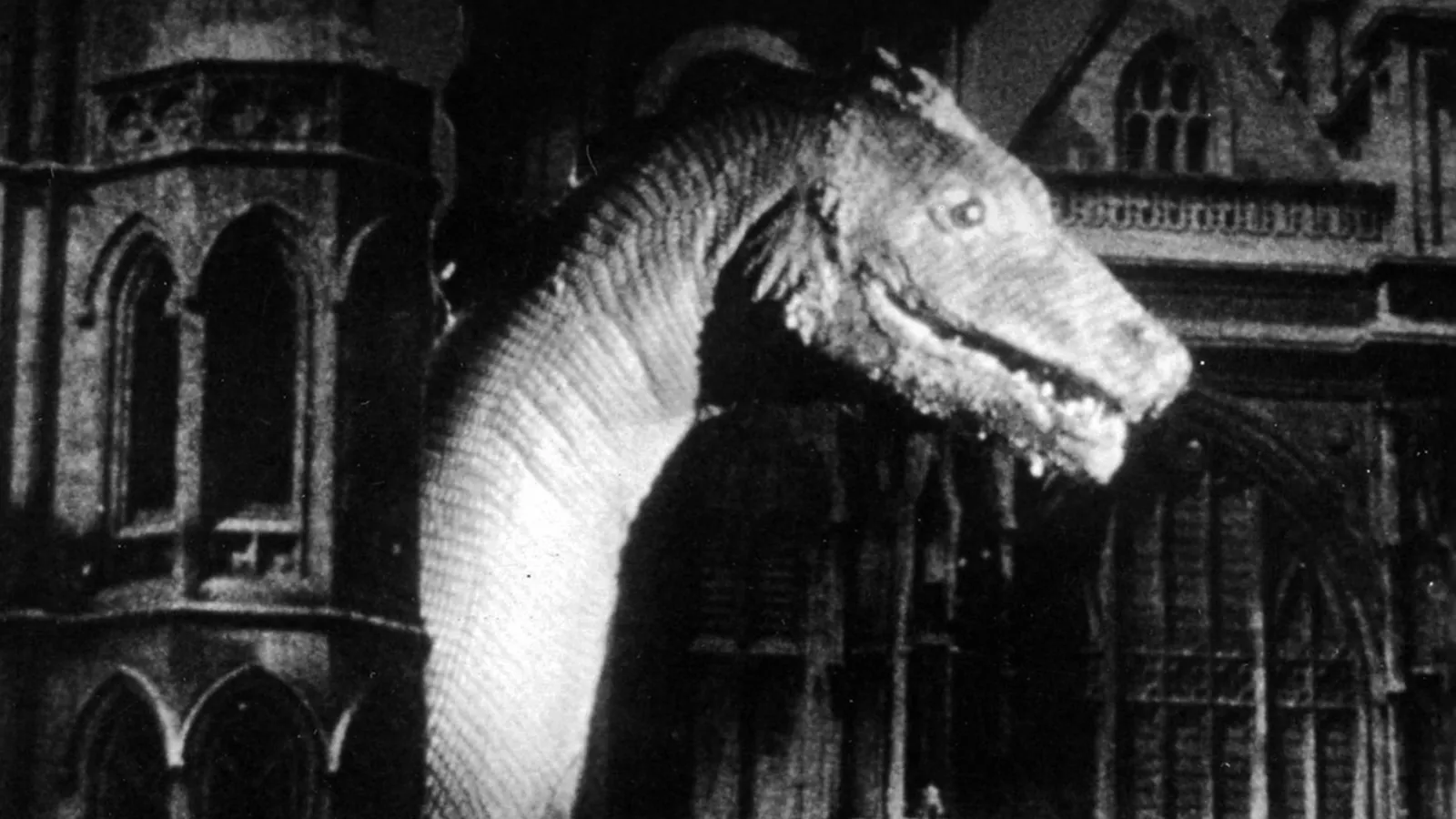
King Kong's animator worked on this London sea monster
Behemoth the Sea Monster (1958) has stop-motion effects supervised by Willis O'Brien, the animator behind King Kong.
By Relay, Movie Spotlight · Thursday, October 15, 2026 · 3 min read
Behemoth the Sea Monster was made in 1958 and directed by Eugène Lourié, a Russian-born designer turned director, and it is a monster film whose stop-motion animation was supervised by Willis O'Brien, the effects pioneer who animated King Kong in 1933. The creature it produced comes out of the sea and wrecks London.
The story starts with a warning. A marine biologist says nuclear tests have contaminated the oceans. A Cornish fisherman dies of severe burns after claiming a sea monster attacked him, and dead fish wash up along the coast. The trail leads to a radioactive prehistoric creature that attacks a ferry and then heads for London, where the military cannot use conventional weapons for fear of spreading radiation across the country.
Why a British film has a monster made in Los Angeles
The AFI Catalog, the American Film Institute's record of US releases, dates production from mid-April to mid-May 1958 at National Studios in Elstree, England, with location work in Cornwall, Essex and London.
The monster was not filmed there. The stop-motion model effects were made in a Los Angeles studio and combined with the British footage afterward. The film reached US theaters in March 1959 from the studio Allied Artists as The Giant Behemoth. Behemoth the Sea Monster is its British title, and the one used on Relay. The British release also credits Douglas Hickox, a second-unit director making his directing debut, as co-director with Lourié. US prints did not.
Who made the monster move
TCM describes O'Brien as the master technician who perfected stop-motion, a technique in which a model is photographed one frame at a time and moved slightly between frames, on King Kong. He was also technical creator on Mighty Joe Young in 1949, which won the 1950 Academy Award for special effects. On this film he supervised the animation, but TCM reports that the producers did not let him oversee all the effects, and much of that work was contracted out. The AFI Catalog credits other effects specialists, among them Jack Rabin, Irving Block and Louis DeWitt, alongside O'Brien and his assistant Pete Peterson.
Peterson did most of the hands-on animation. TCM notes that he did it while suffering from multiple sclerosis. The two had already worked together on The Black Scorpion in 1957, another giant-creature film.
The film also borrows from Kong directly: screams from King Kong are reused in the ferry attack and the London scenes, as TCM notes.
Where the story came from
The film began as a story about a radioactive blob, in the style of 1950s nuclear-fear science fiction. The film's backers wanted a physical monster in the manner of The Beast from 20,000 Fathoms, the 1953 film that was Lourié's first as a director, and the story was changed. Lourié directed both.
Glenn Erickson, the critic behind the DVD Savant review site, calls Behemoth an almost verbatim clone of the earlier film. He also singles out the animation: a couple of good minutes of it by Peterson, directed by O'Brien.
Lourié came to directing from design. He had been an art director on the Jean Renoir films and on Charlie Chaplin's Limelight in 1952. TCM quotes him on the two monster films: one was cheap in dollars and the other cheap in English pounds.
Who it is for
The film suits viewers who like 1950s creature features, anyone curious how the stop-motion work behind King Kong carried into the late 1950s, and people who like to see a London skyline wrecked in black and white. The US release ran 80 minutes. The copy on Relay runs 69.
Behemoth the Sea Monster
Eugène Lourié · 1958 · 69 min