Movie Spotlight: First Spaceship on Venus
An East German sci-fi epic so politically charged that the author disowned it, a West Berlin newspaper mistook its prop for a failed Soviet rocket, and it quietly put cinema's first Black astronaut in the cockpit six years before Star Trek.
By Relay · Thursday, April 2, 2026 · 4 min read
In 1960, East Germany built a spaceship and launched it at Venus. It started a newspaper panic in West Berlin. First Spaceship on Venus, originally Der schweigende Stern (The Silent Star), is an ice-cold relic of the Space Race. The film got so tangled in Cold War politics that the author of the source novel tried to get his name pulled from the credits. American distributors surgically removed every reference to Hiroshima. A tabloid photographer mistook the prop rocket for evidence of a secret Soviet launch failure. Against all odds, the thing is genuinely beautiful.
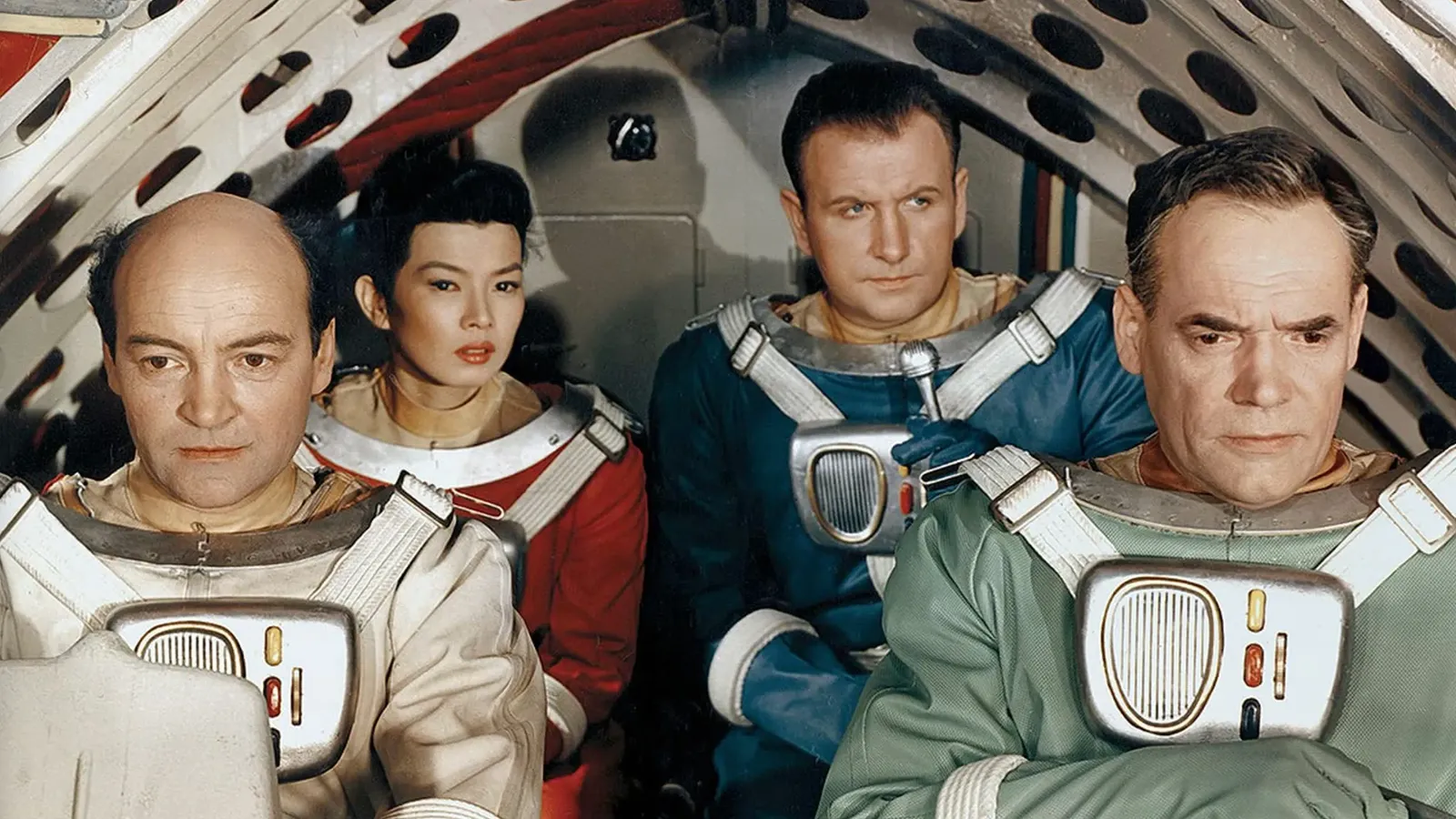
The setup is classic atomic-age paranoia with a utopian twist. A mysterious artifact surfaces in the Gobi Desert, traced to a transmission from Venus. An international crew boards a nuclear-powered ship called the Cosmostrator to investigate: Russian, German, Japanese, Chinese, Indian, American, African. What they find is a dead civilization that destroyed itself with its own weapons.
The metaphor is not subtle. It was never meant to be.
The Author Who Hated Everything
The film is based on Stanisław Lem's debut novel The Astronauts (1951). Lem wanted nothing to do with it. He called the screenplay "trashy," said the film "practically delivered speeches about the struggle for peace." Ironic, since the novel was itself written under Stalinist pressure. Lem later disowned the book too: "My first science-fiction novels lack any value, despite the fact that I gained world acclaim through their numerous editions."
This was not a man who mellowed with age. He called Tarkovsky's Solaris "Crime and Punishment in space." The only film adaptation he ever approved of was a 1968 short by Andrzej Wajda. Consistent to the end.
Cinema's First Black Astronaut Was a Medical Student
Six years before Nichelle Nichols stepped onto the bridge of the Enterprise, a Nigerian medical student named Julius Ongewe was cast as Talua, the African communications officer aboard the Cosmostrator. He was studying medicine in Leipzig. Zero acting credits. When asked if he'd continue in film, he reportedly said he'd serve his country better as a physician.
It was his only screen role. He may be the first Black astronaut in cinema history. He chose a stethoscope over a sequel.
The Newspaper Hoax
During production at Berlin-Johannisthal airfield, the West Berlin newspaper Der Kurier ran a front-page story presenting the film's spaceship mockup as evidence of a failed Soviet spaceflight attempt in the occupation zone. A prop rocket, some barbed wire, a jumpy photographer. Suddenly you've got a Cold War incident. The production team must have loved it.
The Metropolis Connection
The special effects were supervised by Ernst Kunstmann, who had worked on Fritz Lang's Metropolis in 1927. He revived the "Schüfftan process," an in-camera compositing trick using partially silvered mirrors that he'd helped pioneer three decades earlier. The same man. The same mirrors. Thirty-three years apart. One built a dystopian city, the other built a dead planet.
How America Lobotomized It
Crown International Pictures bought the US rights, hacked out fifteen-plus minutes, performed an extraordinary act of political surgery. Every reference to Hiroshima was stripped. In the original, the Japanese doctor Sumiko tells a crewmate she can't have children because of the radiation. When she sees the destroyed Venusian city, she whispers "Hiroshima." In the American dub, she barely audibly mumbles "...all the damage..."
They swapped nationalities wholesale. The East German pilot became American. The American scientist became Russian. The Russian became American. The original electronic score by Andrzej Markowski, one of the earliest extensive electronic film soundtracks, was replaced with stock music. Crown released it on Halloween 1962, double-billed with Varan the Unbelievable, under three different titles simultaneously.
Nina Hagen's Mom, Brecht's Protégé
Keep your eyes open for a journalist in an early scene. That's Eva-Maria Hagen, known as the "Brigitte Bardot of the GDR." She made her theater debut in 1953 in a production directed by Bertolt Brecht himself. Her daughter, Nina Hagen, would become the godmother of German punk. Eva-Maria had her GDR citizenship revoked in 1977. She emigrated west.
Director Kurt Maetzig had lost his own work permit under the Nazis in 1937 because his mother was Jewish. He co-founded DEFA to rebuild German cinema from rubble, made The Silent Star as the studio's most expensive production ever. Lived to 101.
The film sold over four million tickets in Europe. MST3K got hold of it in 1990. Alex Cox, the director of Repo Man and Sid and Nancy, wrote in The Guardian that its images of melted cities and crystallized forests are "masterpieces of production design." The ship's chess-playing robot Omega, a squat little tank-treaded unit with a round central eye, has been cited as a possible ancestor of R2-D2.
It was made by people who had survived actual fascism, actual war, actual occupation. They were trying to say something about what happens when a civilization points its best technology at itself. The message got garbled by censors on both sides of the Wall. That only makes it more worth hearing now.
Streaming now on Relay.