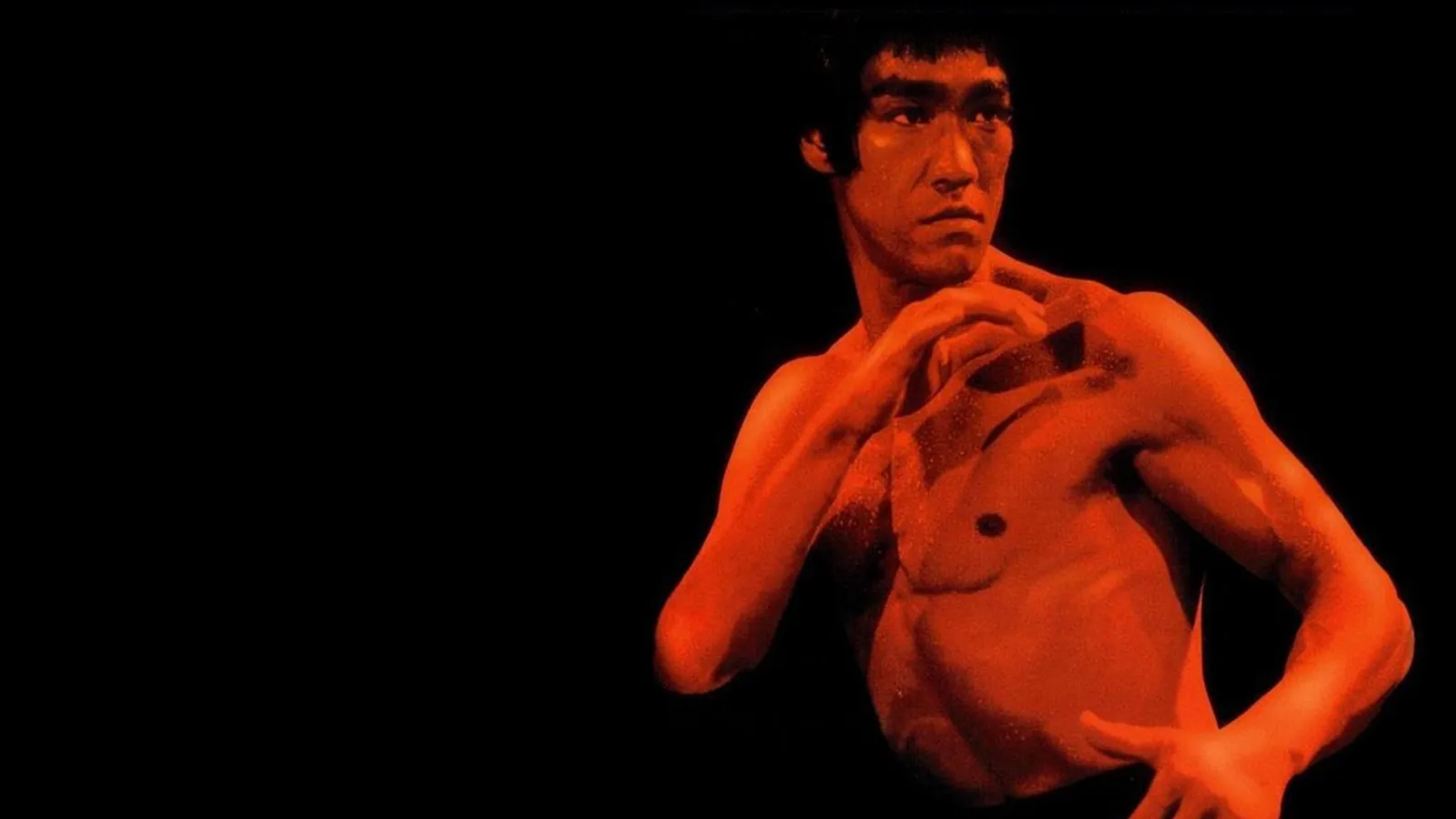
Bruce Lee's second film broke the record his first set
Fist of Fury (1972) took about HK$4.43 million in Hong Kong, beating the record Bruce Lee set a year earlier with The Big Boss.
By Relay, Movie Spotlight · Saturday, October 10, 2026 · 3 min read
Bruce Lee's first starring film, The Big Boss, set a Hong Kong box office record in 1971. His second broke it. Fist of Fury opened on 22 March 1972 and took about HK$4.43 million in Hong Kong, enough to beat the record his debut had set a year earlier.
It was his second film for the Golden Harvest studio and director Lo Wei. The story is simple. Lee plays Chen Zhen, a student of the late martial arts master Huo Yuanjia, who finds his teacher dead and a rival Japanese dojo gloating over it. What he does next is among the best-known sequences in kung fu cinema, and it was shot in Hong Kong and Macao, not Shanghai. The story has been retold since, most notably in Fist of Legend (1994), a remake starring Jet Li, the martial arts star.
Shanghai, built in Kowloon
Most of the film was shot at the Golden Harvest studio in Kowloon, with a few exteriors in nearby Macao. The park gate scene, where Chen is barred at the entrance by a sign and kicks it to pieces, was filmed at the Luis de Camoes Garden there. It stands in for Huangpu Park, the Shanghai garden that catered to the city's foreign residents.
That scene is why the film mattered in China. In it, a sign bars "dogs and Chinese." Historians Robert Bickers and Jeffrey Wasserstrom concluded in 1995 that no such sign existed: the real one listed ten rules, including that the gardens were reserved for the foreign community. The legend has lasted as a symbol of national humiliation, and the film put it on screen.
Macao filled in elsewhere too. Lee's character, disguised as a rickshaw puller, runs through a street behind the Ruins of St. Paul, filmed there because the Golden Harvest backlot in Hong Kong lacked the space.
Who wrote it, who fought it
Director Lo Wei took the writing credit, but the Hong Kong writer Ni Kuang had a hand in the script, according to his Variety obituary. Lee and Lo frequently clashed, and Lee arranged the fights himself.
One of those fights was with Robert Baker, a student of Lee's from California, who played the Russian strongman Petrov in his acting debut. Baker said most of their fight was real sparring, that the bite Lee takes at his leg was real, and that he moved so fast he nearly pulled out Lee's teeth.
The kick Jackie Chan took
Jackie Chan was 18 when he joined the crew. He appears as an extra, and he doubled for the villain, Suzuki, when Lee's character boots him through a window.
A hit in Japan, and a frozen ending
The villains are Japanese, and the film still did well there. It opened in Japan on 20 July 1974 and became the seventh highest-grossing film of the year, with about 600 million yen in distributor rentals.
In the US, a distributor swapped the titles of Lee's first two films. The Big Boss went out as Fists of Fury, and this one became The Chinese Connection. It reached number one on the US box office chart in June 1973.
Under either name it ends the same way. Chen walks out to face armed police and soldiers to protect his school, launches a flying kick, and the picture freezes in mid-air as shots ring out. Critics have linked that final image to the fatalism of Butch Cassidy and the Sundance Kid, which came out only a few years earlier, in 1969.
It runs 106 minutes, it is rough and furious, and the dojo fight still holds up. In my view it is the one that proved the first was no fluke.
Fist of Fury
Lo Wei · 1972 · 106 min