Movie Spotlight: Iran: The Great Game
The history behind the headlines. A documentary tracing the U.S.-Iran relationship from a 1953 CIA coup to the current conflict, told through declassified documents, interviews, and the people caught in between.
By Relay · Tuesday, April 7, 2026 · 4 min read
Kermit Roosevelt Jr. was Teddy's grandson. In 1953 he walked into a Tehran basement with a suitcase of cash. His assignment: regime change. He hired strongmen from the zurkhaneh gyms to stage demonstrations, paid newspaper editors to run planted stories, coordinated with military officers sympathetic to the Shah. The Eisenhower administration viewed Mosaddegh's oil nationalization through Cold War optics, a potential Soviet foothold. Britain, which had seen its Anglo-Iranian Oil Company revenues disappear overnight, pushed hard for intervention.
The first coup attempt failed. The Shah fled to Rome. CIA headquarters told Roosevelt to pull out. He stayed. Four days later tanks rolled up to Mosaddegh's house. Iran's elected government was gone.
That was seventy-three years ago. Right now U.S. and Israeli forces are striking Iranian nuclear sites. The Strait of Hormuz is contested. Ceasefire proposals are being rejected on both sides. The conflict dominates every screen but the backstory rarely makes it past a chyron.
How did we get here?
Iran: The Great Game tries to answer that. Director Igor Lopatonok puts Oliver Stone and economist Jeffrey Sachs on camera alongside Iranian officials and analysts. The film has a clear perspective. It's sympathetic to Iran's grievances. But the historical record it walks through is worth knowing regardless of where you land politically.
The Oil Equation
The Anglo-Iranian Oil Company was paying Iran a smaller share of oil profits than it paid in British taxes. Mosaddegh nationalized the industry in 1951 to change that ratio. Britain imposed a naval blockade and froze Iranian assets. Truman declined to help remove him. Eisenhower, persuaded by a Cold War framing, approved the operation.
The company at the center of the dispute later rebranded. It's now called BP.
The CIA didn't officially acknowledge its role until 2013. Sixty years after the fact. The coup restored the Shah, whose U.S.-trained secret police, SAVAK, kept domestic opposition in check for 26 years. When the 1979 revolution came, the grievances were specific. Secretary of State Madeleine Albright acknowledged them in 2000: "The coup was clearly a setback for Iran's political development, and it is easy to see now why many Iranians continue to resent this intervention."
The Islamic Republic that emerged from 1979 carried its own record. Support for Hezbollah, Hamas, and other proxy forces across the region. A brutal crackdown on internal dissent. Hostage-taking at the U.S. embassy. The relationship froze into mutual suspicion with plenty of legitimate grievances on both sides.
The Soleimani Strike
January 3, 2020. An MQ-9 Reaper drone fired four Hellfire missiles at a convoy leaving Baghdad International Airport. Qasem Soleimani, head of the IRGC's Quds Force and architect of Iran's proxy network across Iraq, Syria, Lebanon, and Yemen, was killed. He was identified afterward by a turquoise aqeeq ring. One of the few body parts they could recover.
Soleimani was, depending on who you ask, either a terrorist responsible for hundreds of American deaths through IEDs and proxy operations in Iraq, or a military strategist who helped defeat ISIS when Baghdad was at risk of falling in 2014. Both things can be true.
The film highlights one contested detail: Iraqi PM Adel Abdul-Mahdi told parliament that Soleimani was carrying a diplomatic response to a Saudi de-escalation proposal. The Trump administration cited an "imminent threat" but didn't release evidence publicly. The legal basis was the 2002 Iraq War authorization.
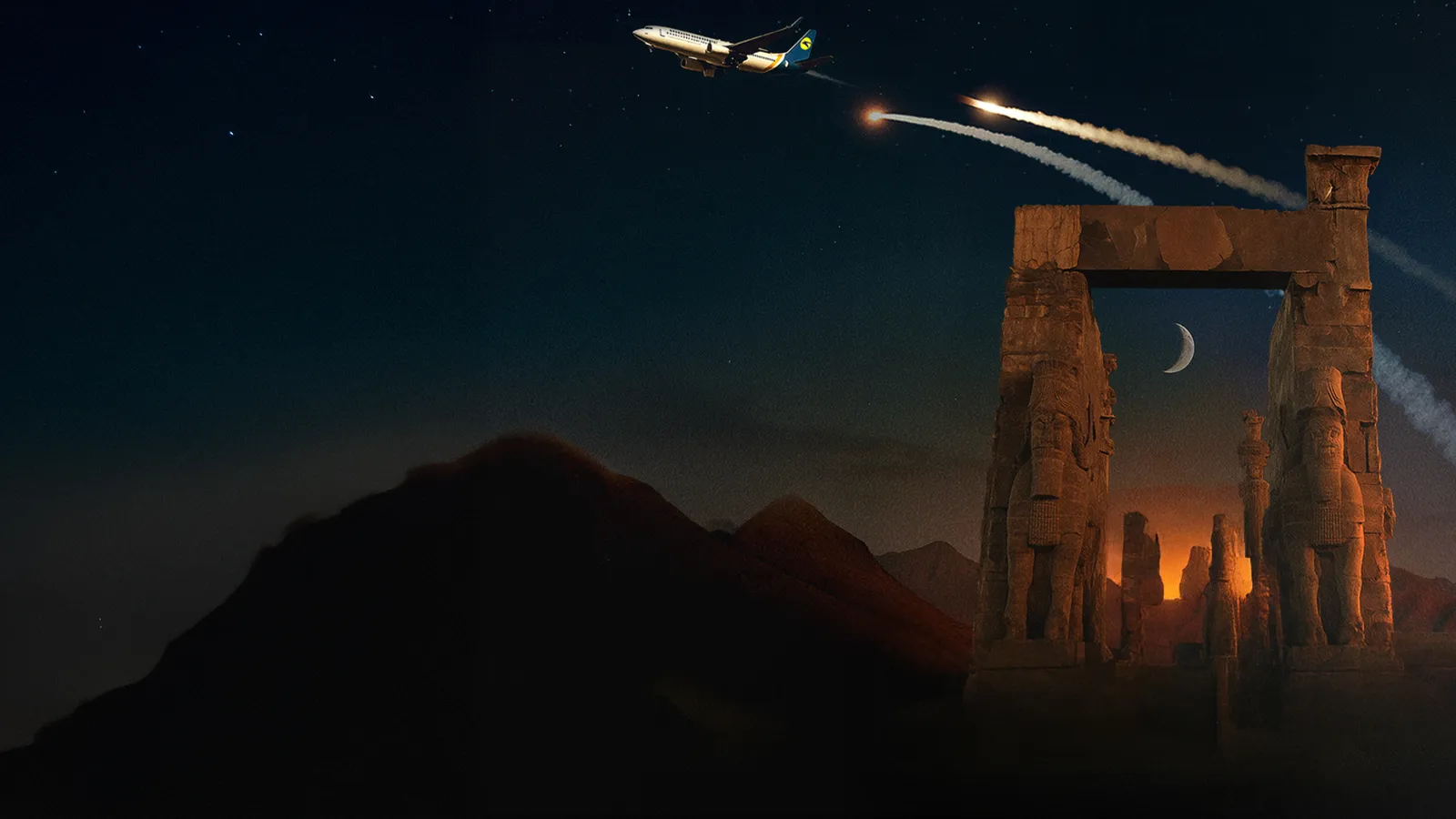
Five days later, an IRGC air defense operator had seconds to decide if a radar contact was a cruise missile or a commercial flight. Iran had just launched ballistic missiles at an American base. Everyone was bracing for a counterstrike. Communications with his chain of command were reportedly down.
He fired.
Ukraine International Airlines Flight 752. 176 people. Students heading back to Canadian universities. Iran denied responsibility for three days before admitting the shootdown under international pressure. A Canadian court later ruled it intentional.
The Nuclear Thread
There's an irony the film spends real time on. Under Eisenhower's "Atoms for Peace" program, the United States provided Iran with its first nuclear reactor. The Tehran Research Reactor, 1967. American companies held contracts to build Iranian nuclear infrastructure through the seventies. The Shah's nuclear program had Washington's full support.
After 1979, that same program became a security concern. Iran's enrichment activities, its restrictions on IAEA inspectors, its progress toward weapons-grade uranium. These were the triggers for decades of sanctions, negotiations, the 2015 JCPOA deal, and its collapse.
Now Bushehr, Iran's only functioning power plant, completed with Russian assistance, has been struck multiple times. IAEA Director-General Rafael Grossi has warned that strikes near the facility "could cause a severe radiological accident with harmful consequences for people and the environment in Iran and beyond." Iran, Russia, and nuclear watchdogs have all flagged the risks.
The Pattern
1953: Western powers intervened in Iran over oil.
2026: the conflict plays out while the strait that carries a fifth of the world's oil supply is contested.
The film doesn't pretend to be balanced. It was made by people who believe Western policy toward Iran has been catastrophic. You can engage with that argument or push back against it. But the documents are real. The declassified cables are real. The photographs of Mosaddegh governing from his bed in pajamas, weeping during speeches, the elected leader of a country that produced the world's first declaration of human rights. Those are real.
So is everything happening right now.
Iran: The Great Game
Igor Lopatonok · 2025 · 115 min
Streaming now on Relay.