Movie Spotlight: Masquerade Match
A college student builds a flawless dating profile out of lies, meets her ideal match, and walks straight into a romance built on hidden things. Producer Chiharu Morinaga on the swipe-era anxiety behind Masquerade Match.
By Relay · Tuesday, May 12, 2026 · 4 min read
Dating apps promise efficiency, and efficiency has a cost. Every profile is a pitch deck. Every photo is a thumbnail trying to survive a swipe. Somewhere in that calculus, the person doing the swiping starts editing themselves to win, and the version that wins is rarely the one that actually shows up on the first date.
That gap is where Chiharu Morinaga went looking. Masquerade Match, known in Japanese as Kamen Sensou, follows Suzu, a college student who builds a flawless profile out of lies and meets the boy who matches it back. Then it asks a question the genre usually avoids. Can a relationship that starts in a costume ever take the costume off?
The mask is the whole movie
The title translates roughly as “mask war,” and Morinaga is precise about what the mask actually is. “In this film, the ‘mask’ represents the act of suppressing your true self to perform a character for others. It’s not just about changing your appearance, it’s about falsifying your inner self.” The expression she keeps coming back to is “wearing a false mask,” which is how she names the slow erasure that happens when you spend long enough trying to be liked.
You see it in Suzu before you hear it. Her true self, Morinaga says, is “the kind of girl who rolls out of bed and bolts out the door in a gray tracksuit to get to class.” After she meets Ren through the app, the makeup tutorials start. The fashion studying starts. The transformation is dramatic enough to do its own work onscreen, before anyone has to explain it.
Kai knows. Ren doesn’t.
The film’s emotional engine is the difference between two boys and what each of them sees. Kai is the childhood friend who mocks Suzu, bickers with her, knows the version of her that doesn’t comb her hair. Ren is the curated stranger from the app, the one she dresses up for. Morinaga frames the asymmetry plainly. “Because Kai knows her past and her flaws, Suzu feels no need to pretend. Conversely, around Ren, she feels the pressure to be the ‘ideal woman,’ which ironically stifles the rich, emotional charm she naturally possesses.”
So Suzu is two people. Stretched and elegant in one frame, loose and combustible in the next. “No matter how much she dresses up, her true self leaks out when she’s with Kai. I believe that gap is exactly what makes her a charming character.”
Glitches in the perfect match
Ren is supposed to feel like the win, but Morinaga wanted the audience to itch. “I wanted Ren to be the perfect match on the surface, but with an underlying sense that something is ‘off.’” The early app messages give it away if you’re looking. He somehow knows which station is closest to her house before she mentions it. Painful memories surface and his face does something it shouldn’t. He gets framed at a distance, watching Suzu and Kai when they don’t know he’s there.
None of these are reveals. They’re tells. Morinaga calls them glitches, and she worked to keep them subtle enough that you can’t solve the film from them, only feel uneasy.
A campus, a budget, a night view in Odaiba
The film was shot through Aoyama Gakuin University, and the campus is doing real work in the frame. “Since most of the characters are university students, being able to film at an actual university added a great deal of realism to the project. Additionally, because the cast members were close in age to their characters, they were able to naturally capture the specific atmosphere and sense of distance unique to student life.”
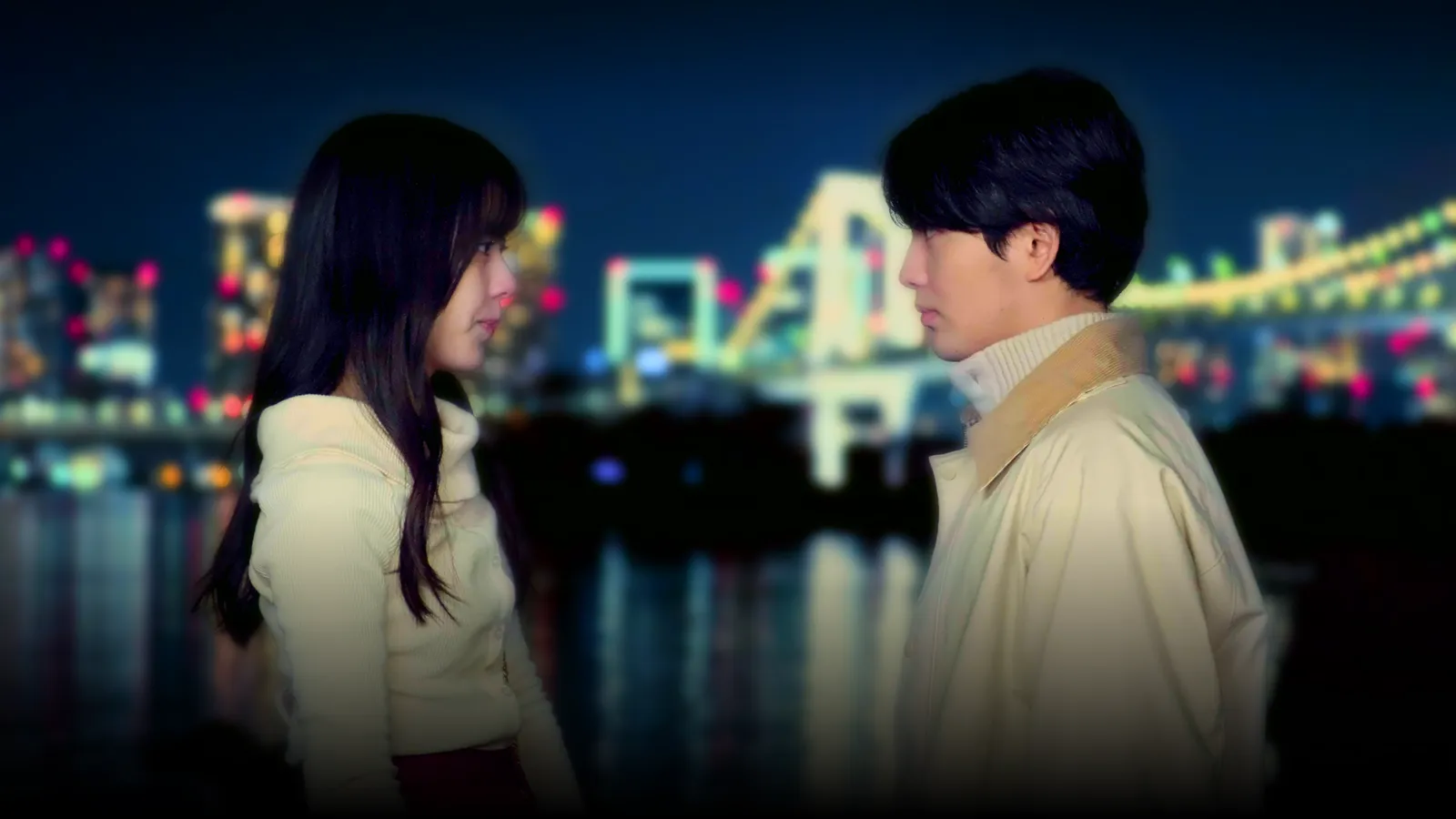
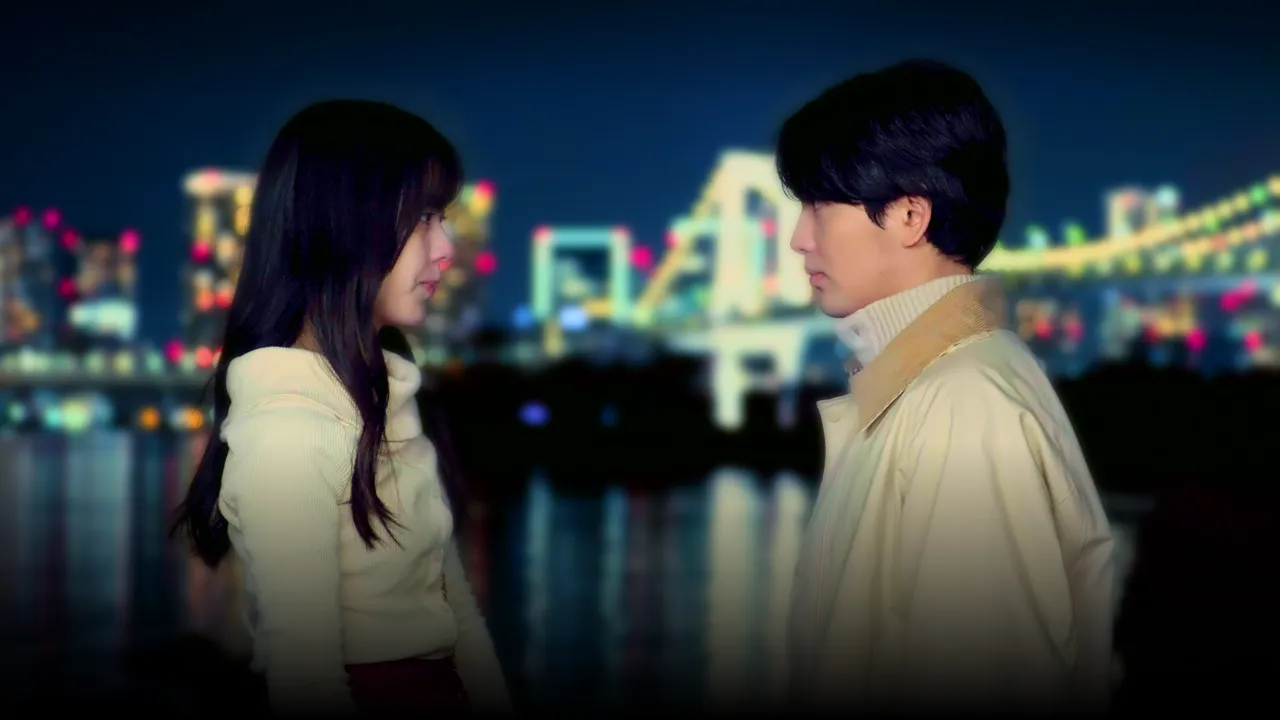
Budget was around ¥800,000, and Morinaga refused to let that flatten the world. They scouted hard for visual variety on campus and then went all the way to Odaiba for the final scene, because they wanted a night view that opened up the frame after a film’s worth of close interiors. “Because we had significant hardware constraints, we invested a massive amount of time into post-production. We obsessed over the details, re-adjusting the color grading countless times and meticulously removing fine noise, to ensure the final image quality was as high as possible.”
The post stack is worth naming. Edit in EDIUS X Pro, color in DaVinci Resolve, 3D in Blender, a 5.1 mix in Studio One Pro 7 for the theatrical run, and RX11 for denoise. FUJIFILM provided cinema cameras and lenses, which is part of why the film looks the way it does.
2.35:1 for a romance
Most romances live in 1.85:1. Masquerade Match goes wider. “We chose Cinemascope (2.35:1) for this project because I didn’t want the romantic elements to become too overwhelming. Since the film is packed with comedy and suspense, using a wider and tighter frame allowed us to create a sense of scale and grandeur for the audience, especially for those watching in a theater.”
The camera doesn’t sit still either. Morinaga’s team avoided locked-off shots wherever they could, leaning on dolly, crane, and dolly zoom to keep a short film moving with feature-scale rhythm. The frame is a romance frame on paper. In practice it’s closer to a thriller frame, which is partly the point.
What to know before you press play
“Kamen Sensou is a ‘new sensation’ romance film that packs in elements of classic love stories, comedy, and even horror,” Morinaga says. “Despite the budget constraints, we were uncompromising when it came to locations and visual storytelling, aiming for a sense of scale and cinematic immersion. I would be thrilled if viewers watched this while reflecting on their own views on love, enjoying the turbulent and unpredictable twists the story takes.”
 Romance
Masquerade Match
Mao Sugitani · 2025 · 60 min
Streaming now on Relay.