Movie Spotlight: Pickleball
A priest. A foreclosure notice. A sport invented on Bainbridge Island that has no business being this competitive. Jay Dee Walters wrote Pickleball as a small-town underdog comedy, and it turned into something he didn't fully expect.
By Relay · Thursday, June 25, 2026 · 4 min read
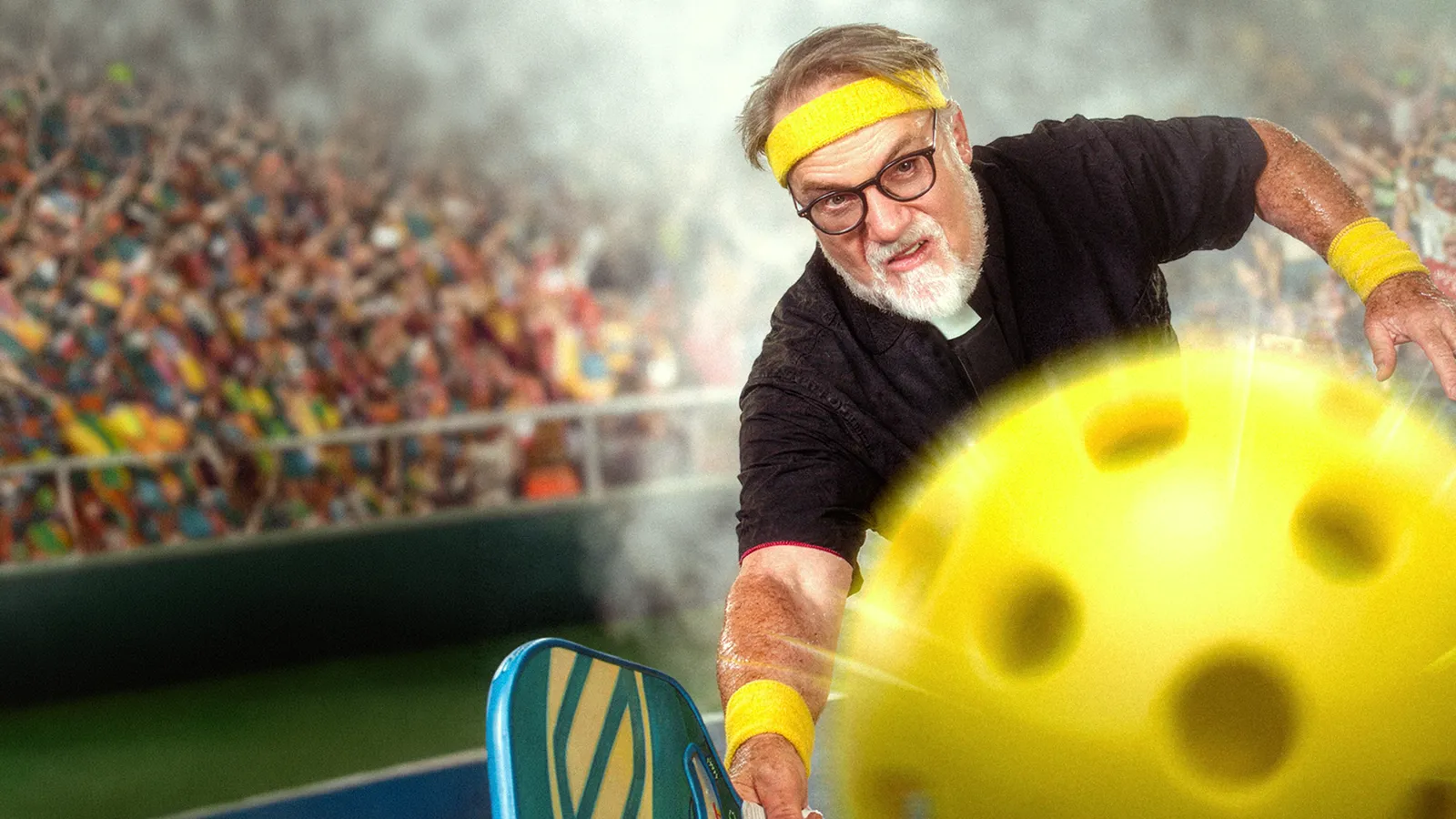
A priest walks into a pickleball tournament. That sentence sounds like the setup for a joke, and in a way, it is. Father Joseph is trying to honor a dead friend, save a community center from foreclosure, and coach a ragtag team that has absolutely no business competing against a cocky tennis legend. It’s a lot. But the film makes it work, mostly because the comedy never forgets that something real is at stake.
Jay Dee Walters wrote Pickleball and plays Barry, one of three brothers at the center of the story. He first heard about the sport on a cruise ship from a friend named Linda Plante. The idea didn’t fully click until he visited Bainbridge Island, Washington, where pickleball was invented. “That is when the lightbulb went off,” he says. “The sport had this growing popularity, a funny name, and a real community feeling around it.”
The right sport for a sports comedy
Walters grew up playing ping pong. When he started looking at pickleball, he saw the same DNA: quick reactions, back-and-forth strategy, the way a casual game can suddenly get serious. He’s also a longtime fan of Dodgeball and Happy Gilmore, films that take sports that seem absurd on the surface and treat them with giant stakes and real underdog energy. Pickleball, he figured, could fit exactly into that world.
“It has a funny name, it is growing fast, and people can get surprisingly serious about it,” he says. That combination gave the film room to have tournament trash talk and ridiculous moments while keeping characters the audience could actually root for.
Father Joseph and a personal reason to care
The priest wasn’t the original center of the story. Kevin Farley, who plays Father Joseph and also served as executive producer, came in as a consultant early in development. It was his idea to make Father Joseph the best friend of Barry, the community center owner who dies before the movie begins. That change gave the character a stake beyond just being a comic anchor. He’s trying to honor someone he loved and protect what that person built.
Walters wanted to show a side of priesthood that films rarely depict. “Father Joseph is still a spiritual figure, but he is also a friend, a competitor, a little overwhelmed, and very human,” he says. That tension, between sincerity and being pulled into the chaos of a pickleball tournament, is a lot of where the comedy comes from.
Three brothers and an old wound
Miles, Earl, and Barry carry the emotional weight of the film. They lost a wife and mother figure years before the story begins, and that kind of loss doesn’t disappear, it just comes out sideways. Through arguments, jokes, competition. Walters describes them as dreamers, each chasing something and trying to prove something. One is a gamer, one is a former tennis pro, and Barry is a self-appointed ladies’ man who is probably not quite as smooth as he thinks.
“The family dynamic became this mix of grief, rivalry, humor, and love,” Walters says. “That is where a lot of the heart of the movie comes from.” Willie Mellina and Justin Sterner play Miles and Earl, and Walters credits them with carrying both the comedy and the family feeling the story needed.
The ensemble and the opponents
Major Dodge plays Bradley Sinclair, the arrogant tennis legend trying to take over the courts. Walters calls him “the ultimate bad guy for this kind of story,” overconfident and exactly the kind of opponent you want the team to beat. Stephanie Parker plays a character whose schemes put the community center in jeopardy in the first place. Gabriel C. Brown shows up as a superfan who Walters describes as “funny, a little weird in the best way.”
Glenn Morshower and Brent Crable play the tournament announcers, and Walters goes out of his way to mention them. “They helped make the tournament feel bigger, funnier, and more official than it probably had any right to be.”
Shot in Texas, with real pickleball players on court
Solomon’s Porch Community Center doesn’t exist outside the film, but it was built from two real locations: Lifepoint Church in Longview, Texas, and Crossing Creeks Country Club. The communities at both places were helpful enough that the small-town feeling came through without having to manufacture it.
The tournament sequences got a boost from a reshoot at Oasis Pickleball Club in Rockwall, Texas, almost a year after the original production dates. Many of the teams in those scenes are actual Oasis members. “You can tell when people actually understand the sport and are having fun being part of it,” Walters says.
Kevin Farley’s real dog Dougie also plays a character named Dougie. Director Jeff Hamm gave Farley significant freedom throughout production, and since Farley was also a producer, those kinds of personal touches got baked in early. Dougie was, by Walters’ account, unpredictable and ornery on set. He kept crew members on their toes, including producer Ray Monts. These are exactly the moments, unplanned and slightly chaotic, that give a film its texture.
What to know before you press play
Walters’ answer to this is direct: “Our main goal is to entertain them and make them laugh.” He hopes Pickleball gives people some nostalgia for the classic underdog sports comedies, the kind where the team shouldn’t have a chance but you’re cheering anyway. You don’t need to know anything about pickleball to watch it. If small-town characters, ridiculous competition, and a team worth rooting for sound good, that’s the film.
Pickleball
Jeff Hamm · 2026 · 113 min
Streaming now on Relay.