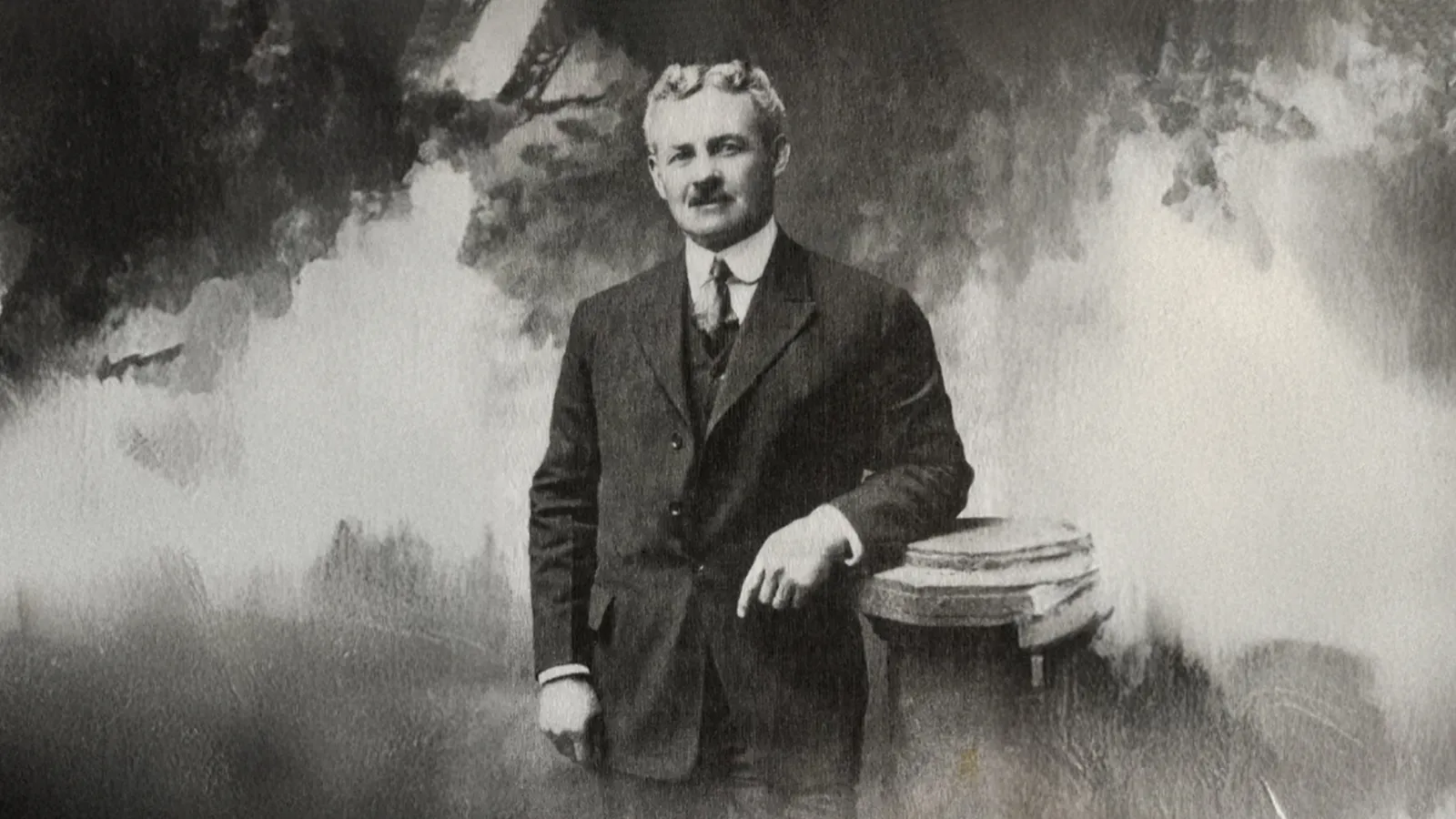
Movie Spotlight: Prof Blood: Basketball's First Great Coach
Director Eric Nemoto on the man who invented the fast break, the platoon system, and modern basketball itself, and whose 159-game winning streak still stands after more than a hundred years.
By Relay · Friday, May 22, 2026 · 5 min read
Most people who watch an NBA fast break, a full-court press, or a coach rotating in a fresh five have no idea they are seeing the ideas of one man. Ernest “Prof” Blood coached at Passaic High School in New Jersey in the early 1900s. His teams won 159 consecutive games, a world record that stands more than a hundred years later. He is in the Basketball Hall of Fame. Almost no one has heard of him.
Director Eric Nemoto first saw the name in the Guinness Book of World Records when he was ten years old, sitting in a bookstore while his mother shopped. He forgot it. Thirty years later he was coaching youth basketball. Another fifteen years passed, he left a career in higher education administration to make films, and a friend mentioned that a man named Chic Hess had written a book about a basketball coach from the early 1900s. When Chic told him about the 159-game streak over lunch, it rang a bell. “I think inherently I must’ve felt this was a surreal prospect,” Nemoto says. Prof Blood: Basketball’s First Great Coach is what came from that lunch.
He Was Before All Other Coaches
Nemoto frames Prof’s contributions with a piece of advice anyone who has played basketball has received: pass before you dribble. “When you think of it, someone had to first come up with the idea,” he says. “Well, Prof was the guy.” Before Blood, basketball scores looked like football scores. Eight to six. Twenty to twelve. Passaic under Blood would score 60, 70, 80, and hit 100 often. He did not just change the speed of the game. He changed what the game was.
Frank Keaney of Rhode Island State is credited with inventing the fast break. The documentary argues otherwise, with evidence. Prof ran a version of it decades before anyone gave it a name. He created a feeder system for younger players before Branch Rickey’s minor league development model existed in baseball. He invented the platoon system, substituting whole lines of fresh players to maintain relentless full-court pressure. He taught the game to E.B. Henderson, who brought it to segregated Black communities in Washington, D.C. He organized the first basketball coaching clinic. The AAU, finding his teams unbeatable with seven players per side, reduced the roster to five. That rule is still in place. His overall record across all programs: 1,268 wins, 165 losses, 88 percent.
The Record That Should Not Still Stand
The 159-game streak ended in 1925. That it continues as the all-time record, more than a century later, is the clearest measure of how unusual this man was. But Nemoto wants viewers to understand what the streak was built from. The fundamentals Blood developed, the pass, the press, the platoon, the feeder system, became so embedded in the game that coaches who never heard his name have been teaching his ideas ever since. “Your coach learned it from his coach, and his coach from his coach,” Nemoto says. Someone had to start that chain. Prof started it.
The Voices in the Film
Three figures carry the documentary’s testimony. Chic Hess, whose book on Prof prompted the whole project, brought deep basketball knowledge along with personal research that covered not just the wins but the politics behind Blood’s eventual departure from Passaic. Bob Hurley Sr., New Jersey’s greatest high school coach by any measure (28 state titles, a record of 1,184 and 125), appears to pay direct tribute. “The greatest New Jersey coach paying homage to the first great New Jersey coach,” Nemoto says. Hurley knew who Prof was. That alone says something. Ernest Benjamin Blood Jr., Prof’s grandson, provided the family photographs and the personal details that make the man feel like someone who actually lived, not a myth assembled from old box scores.
It was Ernie Jr. who suggested the documentary format in the first place. Nemoto had written a feature-length script, but a full fiction film would have cost millions. Ernie provided a budget for the documentary instead, and Nemoto wrote a second script around interviews, flashback scenes, photographs, newspaper images, and narration. The version now in distribution runs just over two hours, trimmed down from a three-hour archive cut made for the family.
Passaic Made It Real
Filming in Passaic changed something about the project. “When you’re dealing with a subject matter that is over one hundred years old,” Nemoto says, “there is a chance that the story will be about the myth of the man.” Visiting the school, the house where Blood lived, the site of the old train station where Passaic held its biggest celebration when the Wonder Team won its first state title, grounded the story in a real place. A working-class community. An everyday man, even if a remarkable one.
He was remarkable in ways that go beyond basketball. A wrestling champion in his youth. A major league baseball player who claimed to have given batting tips to Babe Ruth. A weightlifter before bodybuilding was a thing. He could toss a 16-pound shot put in the air and catch it on the back of his neck. In his sixties, reportedly still capable of making 200 consecutive free throws. He could do one-armed handstands. And he kept a bear named Zep, who traveled with the team and wrestled with Prof before games. When Zep escaped on a train and ran, Prof appeared at the door and called him back. The bear returned.
What to Know Before You Press Play
“A lot of the time, we talk about the tree in coaching,” Nemoto says. Coach K learned from Bobby Knight. Pat Riley played for Adolf Rupp. Rupp played under Phog Allen, considered the father of basketball coaching. “Well, if these coaches and many others make up the tree of coaching, you can think of Prof as the roots of all basketball coaches. He was the first.” With respect to Allen, Blood won over 300 games before Allen had a single win. Everything visible in the modern game, every clinic, every press, every substitution pattern, has a line that runs back to a coach almost no one remembers. This film makes the case for why that should change.
Prof Blood: Basketball's First Great Coach
Eric Nemoto · 2025 · 129 min
Streaming now on Relay.