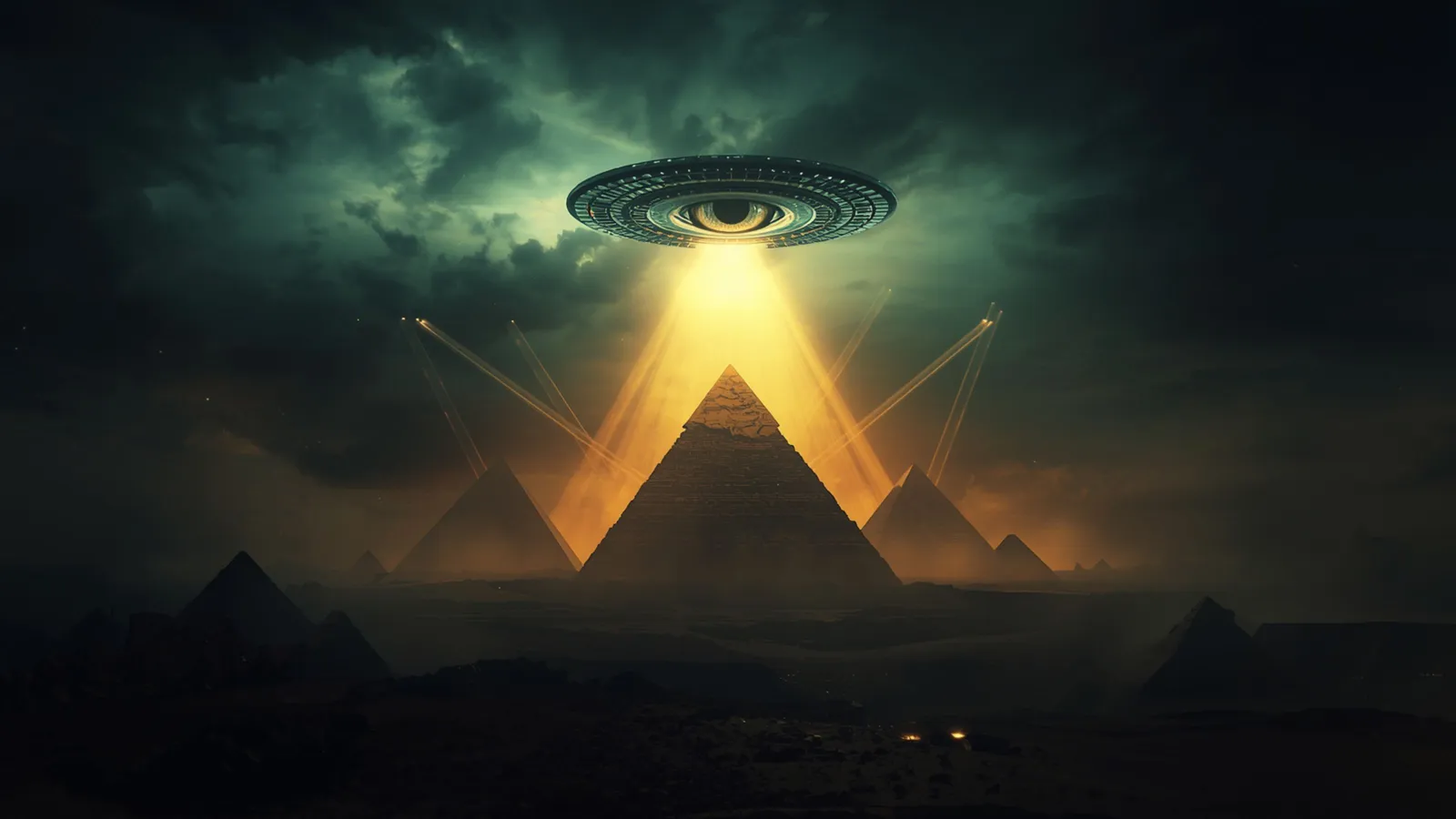
Movie Spotlight: The Day After Disclosure
Director Mark Christopher Lee talks about UFO disclosure, souls versus AI, and why the morning after the reveal matters more than the reveal itself.
By Relay · Wednesday, July 8, 2026 · 4 min read
Say the announcement finally comes. Government confirms it, evidence gets laid on a table somewhere in Washington or Whitehall, and the world wakes up the next morning knowing it is not alone. Then what? That question, the unglamorous logistics of believing something impossible, is the entire premise of this documentary, and it spends almost no time on the reveal itself.
Mark Christopher Lee directed and wrote The Day After Disclosure after three decades circling the same question from different angles: government archives, remote viewing research, and an out of body experience he still describes half as a joke. “I knew it was a real out of body experience,” he said, recalling a night in a new flat when he floated free of his body and noticed a stack of magazines and a book on top of a wardrobe he had never actually looked at. “I checked when I woke and yes I was right.” He is quick to flag the more mundane explanation too, the SSRIs and the alcohol that may have eased him into whatever state let that happen. But the film he built afterward treats the strange and the skeptical as compatible rather than opposed.
Aftermath, not arrival
Lee keeps circling back to one idea: the reveal is the easy part. “President Trump or whoever can get up and announce to the world that we aren’t alone and here’s the evidence,” he said, “but the real question is what comes next, how does the world and its people cope with such profound news.” That reframing pulls the film away from the genre’s usual centerpiece, the moment of proof, toward something closer to a thought experiment about institutions, religion, and ordinary people absorbing a fact too large to process quickly.
Where belief and neutrality split
Lee doesn’t pretend to be a blank slate behind the camera. At one point in the film he tells producer Guy Thompson that artificial intelligence could never hold what he calls the divine spark, that consciousness lives outside the body and can’t be copied or extracted. Asked about drawing that line between interviewer and believer, he didn’t dodge it. “It is my bias based on my own knowledge and instinct and belief that humans and other life have souls,” he said. “AI can’t have a soul, it can only simulate soul, there’s a profound difference. I have an open mind to everything but I will comment on matters in which I feel that I could be right.”
Hope and Project Blue Beam
The film sits inside a real fracture in the UFO research community, and Lee lets both sides speak. One camp treats contact as an evolutionary gift. The other reads it as a test, or worse. Then there is Project Blue Beam, the theory that a staged disclosure event, even a faked alien invasion or second coming, could be used to frighten a population into compliance. “It’s a wild theory, not one in which I believe,” Lee said, “but then again the CIA has always used UFOs and disinformation as a smokescreen from secret tech.” He treats it as one voice in the room rather than the film’s thesis.
Editing the Galileo Project against archons
Structurally, the film swings hard, from Harvard astronomer Avi Loeb’s methodical Galileo Project research to speculation about archons and ley lines inside the same runtime, and Lee is candid about why. “You have to make sure your film has impact and pacing and will keep the viewers watching,” he said. “It’s the reality of film-making these days.” The same instinct shapes how he weighs his talking heads against each other. Nick Pope takes on Blue Beam, Loeb anchors the harder science, and Jeremy Corbell arrives fresh off sitting behind whistleblowers David Grusch, Karl Graves and David Fravor at a congressional hearing. Balancing them, Lee said, is “an art to editing clips together with a wide variety of opinions but also keeping it thematically correct. It’s not easy.”
A very British angle on a global story
Much of the film is staged against British landmarks, Stonehenge and Avebury among them, framed as possible ancient landing sites tied to ley lines and what Lee calls the global energy grid. He sees that as more than local color. “We over here are lagging behind in terms of disclosure,” he said, “but this is a global phenomena and a massive thing in UK culture and folklore. There is a lot of ancient history and knowledge that is lost to us.”
What to know before you press play
Asked what he wants a first time viewer to carry into the film, Lee kept it short. “It’s a weird rollercoaster of a journey deep into the UFO and paranormal world,” he said. “Fasten your seat belts and enjoy the ride.”
The Day After Disclosure
Mark Christopher Lee · 2026 · 107 min
Streaming now on Relay.