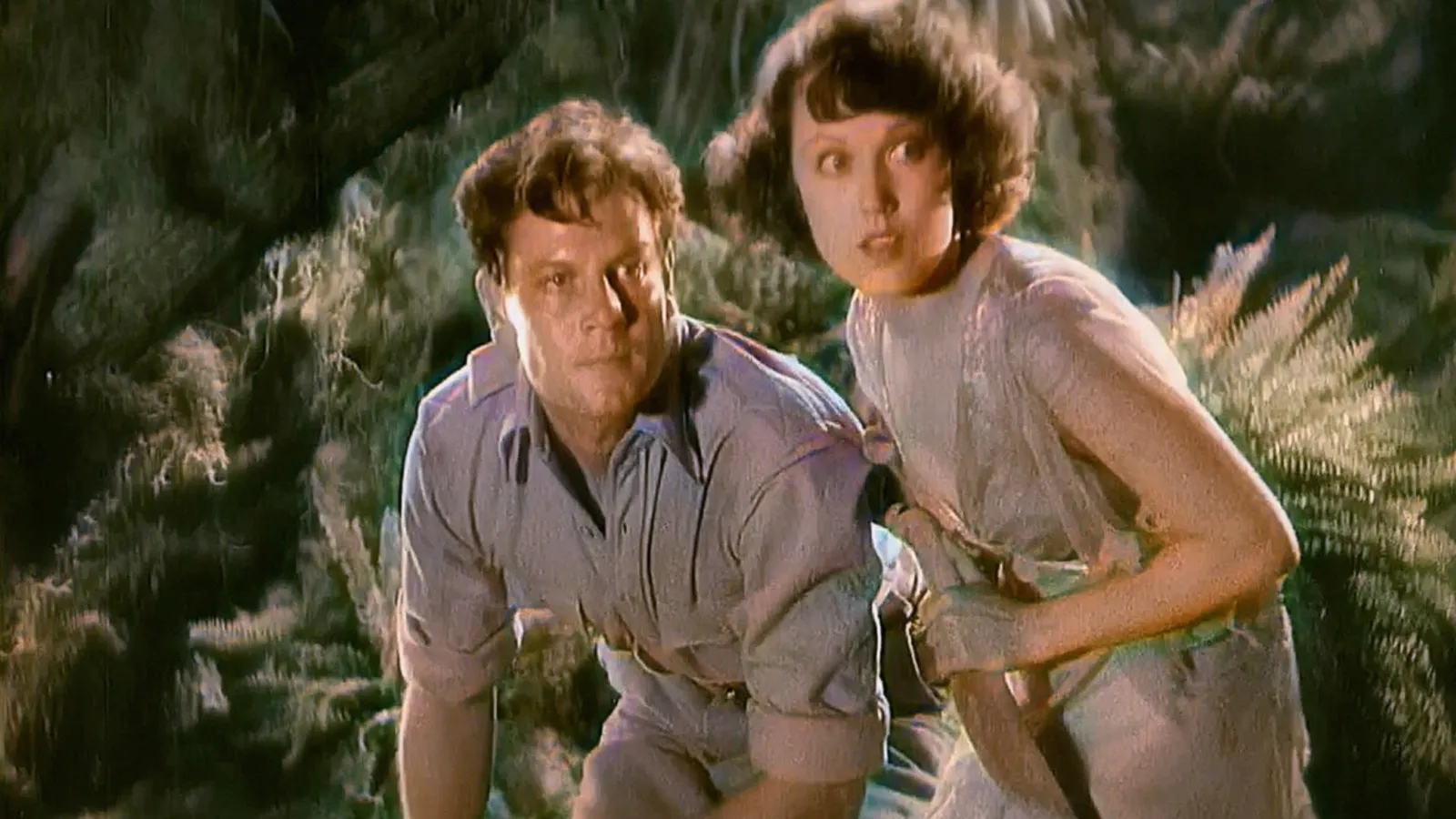
This 1932 human-hunting thriller shared its jungle set with King Kong
The Most Dangerous Game (1932) hunts people on a jungle set King Kong also used, with two of Kong's actors.
By Relay, Movie Spotlight · Saturday, October 24, 2026 · 4 min read
The Most Dangerous Game was made in 1932 by Ernest B. Schoedsack and Merian C. Cooper, the pair who produced and directed King Kong in 1933, and it is the first film of a story about hunting people for sport. The BFI, the British national film institute, says it popularised the idea of a hunter with a taste for stalking human prey, and thrillers have kept using that plot ever since.
The setup is simple. Bob Rainsford, a big-game hunter played by Joel McCrea, survives a shipwreck and washes up on a remote island. Its owner is Count Zaroff, a Russian aristocrat played by Leslie Banks, who welcomes him as a fellow hunter. Zaroff, it turns out, strands survivors of ships on his island and hunts them for sport. Rainsford and two other castaways, a brother and sister named Martin and Eve Trowbridge, become the prey.
Where does the story come from?
The film is based on a short story of the same name by the author Richard Connell, published in the American magazine Collier's on 19 January 1924. The 1932 film was the first film version of it, and the AFI Catalog, the American Film Institute's record of US films, dates its release to 16 September 1932.
It runs only about an hour. The AFI Catalog notes that a preview was timed at 78 minutes, against the 61 or 63 minutes that reached theatres, which suggests it was cut down before release.
Why does it share a jungle with King Kong?
Both films came from RKO, the Hollywood studio, and from the same two filmmakers, and they share more than that. The Most Dangerous Game was shot on jungle sets that King Kong also used, with several of the same crew and actors. Fay Wray, who plays Eve here, plays the woman Kong carries up the skyscraper. Robert Armstrong, who plays her brother Martin, plays the filmmaker Carl Denham in King Kong.
The order of shooting is disputed. Many accounts say this film was shot at night on the Kong sets. The AFI Catalog says it was the other way round: Schoedsack directed Wray and Armstrong on this film by day, then made King Kong with Cooper at night. American Cinematographer, the trade magazine of film photographers, says it is a mistake to think the two were made at the same time, and that Cooper used the jungle set on Stage 12 to shoot test scenes for King Kong.
How was it made so cheaply?
Money was tight. American Cinematographer gives the budget as $202,662 and the schedule as three weeks, with shooting from 16 May to 17 June 1932 and a final cost about $16,000 over. The AFI Catalog, citing studio records, puts the cost at $218,869. That is a small sum for a film with a jungle, a castle and a pack of hounds.
The filmmakers saved money where they could. They reworked the shipwreck so that flash powder and wreckage shots took the place of expensive water tanks, and the whole sequence is 25 shots and about 70 seconds long. Much of the jungle was built indoors on Stage 12 and extended with painted glass.
The music did a lot of the work. Cooper rejected the first score, by Franke Harling, as unsuited to outdoor adventure, and Max Steiner wrote a new one that builds from a three-note hunting call and includes a waltz for the villain. RKO also did not entirely trust Schoedsack with the dramatic scenes, so the director Irving Pichel was assigned to work with him and shares the directing credit.
What did it start?
The film is a pre-Code thriller, which means it was made before Hollywood's strict self-censorship rules took hold, when studios could be franker about violence. American Cinematographer calls it an influential pre-Code thriller that has been remade many times. The AFI Catalog lists two direct remakes, A Game of Death and Run for the Sun.
The BFI goes further and says the film created a small genre of its own, with political themes about the corruption of wealth. In its reading, Rainsford and Zaroff are two sides of the same coin, a hunter who becomes the hunted and the man who hunts him. Later films in the same line, among them Hard Target in 1993, Surviving the Game in 1994 and The Hunt in 2020, put wealthy hunters after poorer prey. The BFI notes that this is the pattern in which the hunters pay a small fortune to hunt the poor.
Critics of the day praised Banks as Zaroff, and he is the reason the film still works: a polite host who treats murder as a sport.
Where it sits on Relay
Relay lists 1,023 films from the 1920s and 1930s, and this is one of them, a thriller from the year before King Kong that shows where a famous jungle set and a famous pair of actors started.
The film suits anyone curious where the human-hunting thriller began, viewers who like old monster-movie sets and a short, fast story, and people who have seen King Kong and want to see what its makers did a year earlier.
The Most Dangerous Game
Ernest B. Schoedsack · 1932 · 62 min