Movie Spotlight: The Way We Speak
Writer-director Ian Ebright built a moody character study around a man who refuses to step back after his best friend suffers a cardiac arrest in the lead-up to their debate, with Patrick Fabian, a Blade Runner color palette, and an editor who worked on Apocalypse Now.
By Relay · Friday, June 5, 2026 · 3 min read
The right move is obvious. His best friend has suffered a cardiac arrest in the lead-up to the debate, throwing the whole thing into jeopardy. Everyone around Simon can see what he is supposed to do. Simon does not do it.
That moment is the engine of The Way We Speak, written and directed by Ian Ebright. The film tracks Simon Harrington, an up-and-coming writer who refuses to step back after his best friend and debate opponent suffers a cardiac arrest leading up to their scheduled debate, choosing instead to pursue a new rival while his ailing wife watches from the margins. Ebright says the story began with something more straightforward: headlines. “Ambition run amok, at every level,” he says. “I felt like I had something worthwhile to say about people losing their way while chasing the prize.”
Failing to read the room
What makes Simon’s trajectory cautionary, Ebright says, isn’t only the good opportunities he corrupts. It’s the smaller moments of failure. His wife and his best friend are both, in different ways, asking him to show up differently. He can’t see it. “Simon is only interested in showing up for Simon,” Ebright says.
Why the debate stage
Ebright was persuaded early on by an idea drawn from documentary filmmaking: that everything is marketing, even when people genuinely believe in what they’re selling. The debate stage gave him a setting where characters perform for an audience while being entirely different behind the curtain. “I love the idea of people who are suffering for different reasons, yet have to smile through it,” he says. “People who are trapped, or have trapped themselves. It’s a great recipe for drama and subtext.”
Building the visual language
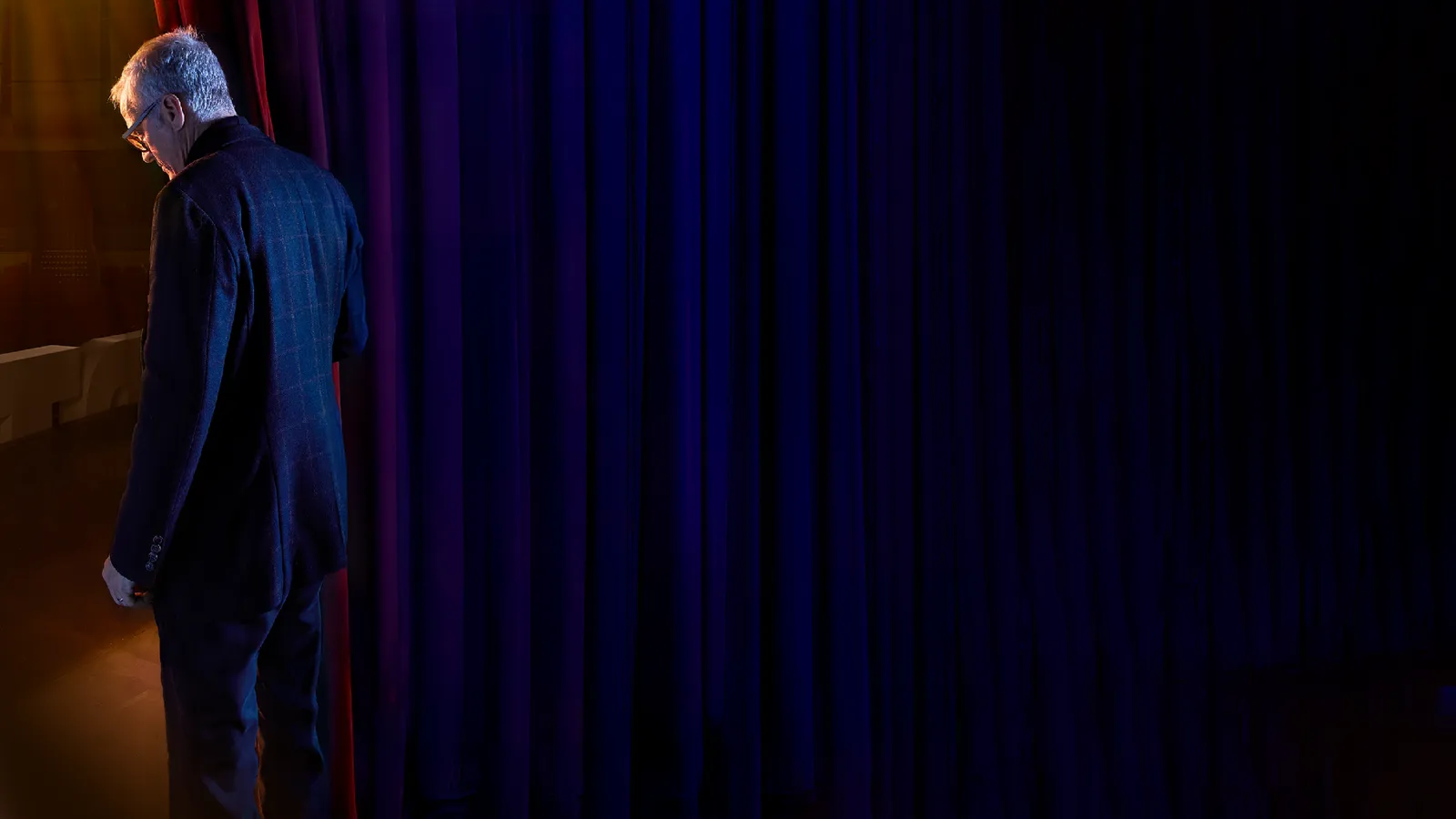
Ebright and director of photography A.J. Marson spent long hours in prep deliberately rejecting what Ebright calls “our grandfather’s earnest drama” — the expected sepia tones and earnest staging. Instead: negative space, low-light ambience, locations chosen for their rich ambient color. A cool palette governs Simon’s disturbing dream sequences and his early-morning disorientation. The visual reference Ebright and Marson kept returning to was Blade Runner.
The tennis-match rhythm of the debates
Debates aren’t inherently cinematic, and Ebright knew it going in. The solution was to treat the escalating confrontations as visual set pieces and build their evolution directly into the shot list. He credits editor Robert Schafer, whose credits include Apocalypse Now: Final Cut, with constructing what Ebright describes as a tennis-match rhythm into the back-and-forth: an almost sports-movie energy playing out in the language of ideas.
Patrick Fabian and the ensemble
Ebright is a devoted Better Call Saul viewer and came to Patrick Fabian convinced he was the actor most capable of holding Simon’s contradictions: compelling enough to follow and slippery enough to distrust. What he found on set was a collaborator. “He and I hit it off, and we were able to contend for new ideas and refine what was on the page together without any of us feeling precious or territorial,” Ebright says. “Those little improvements are all over the film.”
What to know before you press play
“It’s the kind of film that doesn’t come around too often anymore,” Ebright says: “story centered, adult-oriented, character driven, accessible even when it’s about ideas.” He wrote it trying to understand something real about ambition and identity, how people carry their yearnings without quietly sacrificing what they already have. The title, he says, almost feels like it should be spoken in the weary voice of Claire, one of two lighthouse characters in the film who can see clearly what Simon cannot.
The Way We Speak
Ian Ebright · 2024 · 87 min
Streaming now on Relay.