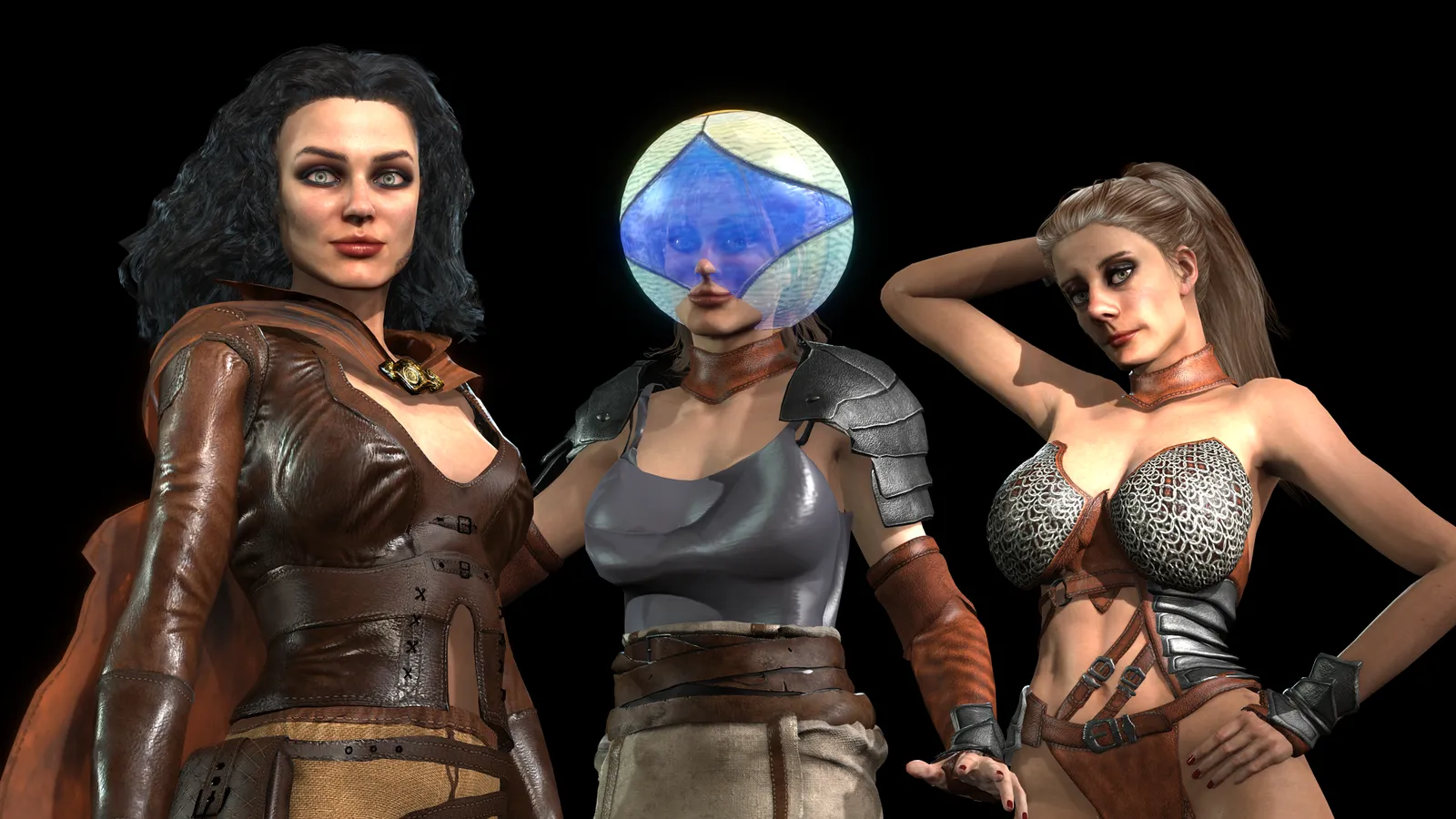
Movie Spotlight: Three Chicks and a Unicorn
Lorenzo West built Three Chicks and a Unicorn alone, without a script, two minutes at a time. The result is a 3D-animated film that folds Roman legions, Hindu cosmology, Nephilim, and flying saucers into a world that treats mythology as real geography.
By Relay · Monday, July 6, 2026 · 4 min read
A UFO sits on the ruins of Mount Olympus. Roman legions guard it. Lord Shiva lives at the bottom of the Baltic Sea. The Akashic Records turn out to be a metal machine drifting in space, occupied by a sleeping robot. None of this is treated as strange. It just is. That tonal confidence, the refusal to blink at its own mythology, is what makes Three Chicks and a Unicorn unlike anything else streaming right now.
Lorenzo West started as a cartoonist. He ran a free comic on Facebook called Frank Doomsday, and three of the characters in it, Meena, Cleo, and Phaedra, kept pulling his attention until he decided they deserved their own story. What came out was a 3D-animated film that folds Roman legions, Egyptian mythology, Hindu cosmology, Nephilim, remote viewing, cyborgs, and flying saucers into a single coherent world. West describes the genre mixing as “a pot of soup. I just kept adding stuff, and it didn’t ruin the taste.”
What the title actually means
The title sounds casual. It isn’t. West says he arrived at it by “reducing it to the lowest denominator,” which is its own kind of precision. The unicorn here is nothing like the glittery, fragile archetype. It’s a Divine cyborg. Clydesdale-sized. It has healing saliva, understands language, and was originally supposed to carry Frank Doomsday into battle before the story veered elsewhere. West notes that what he plans doesn’t always make it to the screen, and that flexibility is part of the method.
Three characters who are not variations on each other
Meena is called “the most dangerous woman in the world” by the Oracle at Delphi. Cleo can remote-view the far end of the universe. Phaedra knows how to kill every living thing on Earth. Each of them has genuine authority, and they’re not interchangeable. West says the characters were built from their appearances after he “perfected them,” and that a lifetime of watching people closely made the distinctions come naturally. What he noticed while writing: “For such a commanding persona, Meena ends up learning the most.”
The boss who gets turned to stone
The tension between Meena and General Ophiuchus plays out almost immediately. She watches him climb toward what she already suspects will get him petrified. She’s right. West describes it plainly: “an annoying boss giving questionable commands and making a mistake, while the employees watch.” The rotating UFO on Olympus was his central image. The power struggle grew from the characters’ personalities colliding, both of them strong, neither inclined to yield.
Mythology as real geography
West spent years researching what he calls “non-political conspiracy theories,” everything from Hollow Earth to secret societies to the Moon Landing. The research left a mark. “As a writer, I felt compelled to breathe life into all of it. To pay homage.” The result is a world where mythological locations are real coordinates. Olympus is rubble. The Baltic Sea floor is a divine residence. The Akashic Records have a physical address in orbit. Mount Olympus doesn’t have a souvenir shop.
Made without a script, two minutes at a time
West wrote the film as he went, completing one or two minutes at a time, music included. He’d scrawl a page of dialogue, reread it until it was in his head, then close the laptop and walk away. When he came back, he’d trim it, add something, and move forward. He invokes Kubrick as a precedent and doesn’t apologize for it. “A screenplay is static. Unalive.” That process explains something about the comedy. The jokes don’t feel inserted because they weren’t. They arrived at the moment West was writing that scene, and if they didn’t work they got cut the next time he opened the file. He says humor comes naturally, that he was sent to the principal’s office for it, and that he’s better at improv than at writing it in advance.
What to know before you press play
West answers this one with a Gladiator quote, attributed to Russell Crowe: “I will give them something they’ve never seen before.” That’s the correct frame for watching Three Chicks and a Unicorn. He built this as a one-person production, writing, directing, producing, composing, and appearing in it himself. He calls that a convenience rather than a constraint, because it meant his complete vision made it to the screen without negotiation. There’s a sequel already twelve minutes in, and a separate series called Plague Lizard that he started when he felt the need to address what he describes as “the troubled Star Wars/Star Trek franchises.” The ending of this film, a dimensional breach, a robot, and then cows, is a genuine setup. He isn’t done with these characters.
Three Chicks and a Unicorn
Lorenzo West · 2025 · 100 min
Streaming now on Relay.