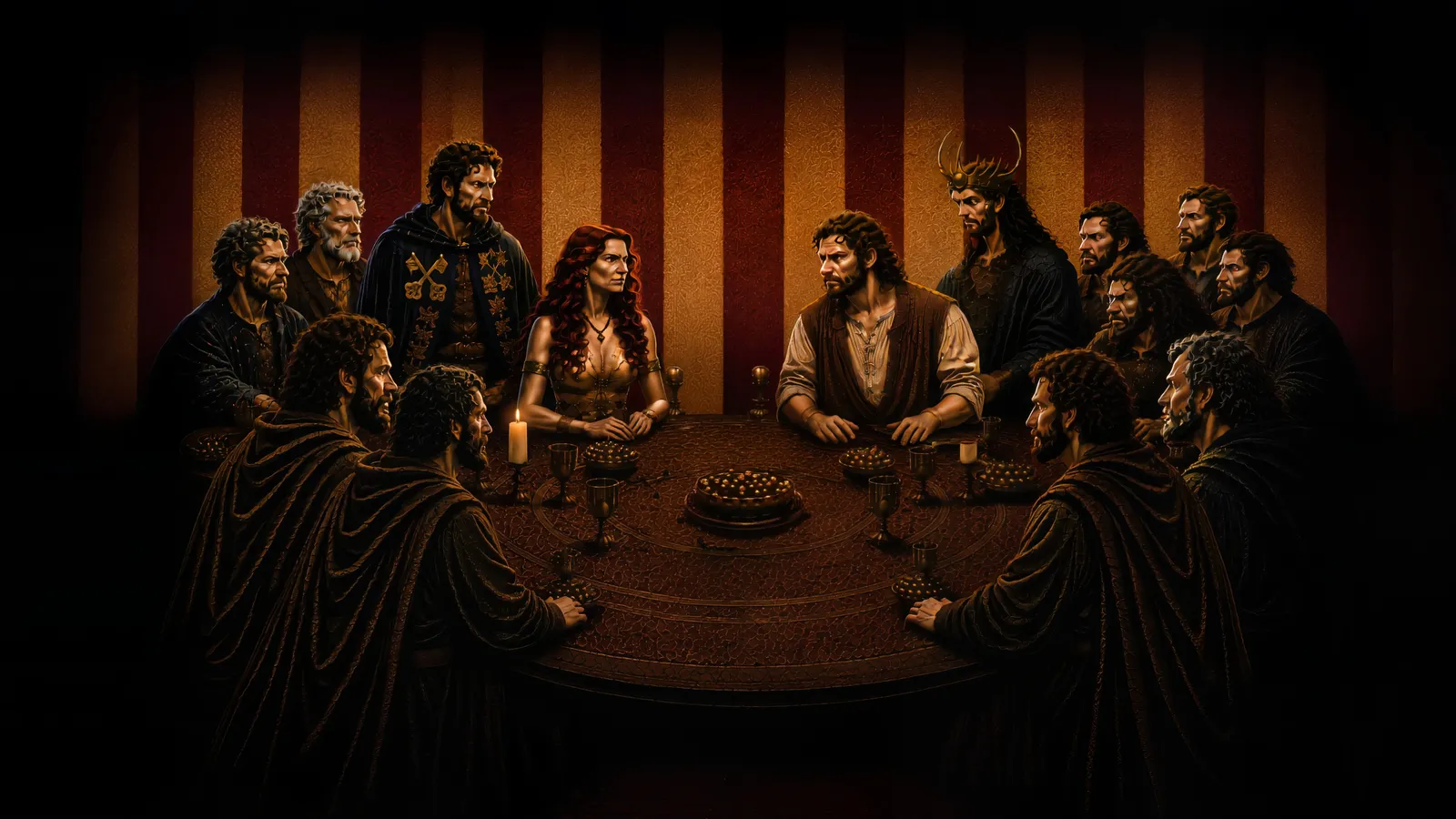
Series Spotlight: The Last Grail
Creator Atticus Clemens traces a single hidden thread of stewardship and power across 7,686 years, from Jeremiah fleeing Jerusalem to a real 1933 plot against Franklin Roosevelt.
By Relay · Monday, July 20, 2026 · 4 min read
Somewhere between a childhood fascination with King Arthur and a much later re-read of The Da Vinci Code, Atticus Clemens landed on a question that wouldn’t leave him alone: nearly every historian agrees Arthur never existed, so how did a story with no proof behind it become one of the most influential legends in English literature? Something that powerful, he figured, doesn’t come from nothing.
The Last Grail is what came out of chasing that question backward, all the way to a number: 7,686 years. Clemens wrote, directed, and produced the whole series himself, tracing a single thread of stewardship and hidden influence from the dawn of agriculture through Jeremiah’s flight from a burning Jerusalem, a real 1933 plot to overthrow the American government, and finally into a speculative future among the stars.
Where 7,686 actually comes from
The number sounds too specific to be arbitrary, and Clemens said it was earned rather than invented. He first chased the idea that the Noah story preserved memory of a lost advanced civilization, but the evidence wasn’t there. “A catastrophe large enough to erase such a civilization would leave geological signatures, and an advanced metalworking society would leave an archaeological footprint,” he said. “Neither exists.” That sent him toward a better question: why did modern humans exist for roughly 200,000 years before civilization suddenly accelerated. The answer kept coming back to climate and agriculture, stable growing seasons emerging around 12,000 years ago, and from there, a line all the way to Enoch as the first steward of what becomes the Grail tradition. “The number was not the premise,” Clemens said. “It was the destination.”
Why it isn’t called The Gray Network anymore
The series carried a different title for most of its life, one that referred to the modern-day organization at the center of its present-day storyline. Clemens changed it right after that version premiered on Relay. “When I looked at the Relay homepage and saw The Gray Network alongside twenty other thumbnails, I had a simple realization: unless someone already knew the story, the title didn’t tell them anything,” he said. The Last Grail does something a working title never could. “Almost everyone recognizes the word ‘Grail,’ but pairing it with ‘Last’ naturally invites curiosity. Why is it the last Grail? What happened to the others?”
A prophet as the hinge of eight thousand years
Instead of opening with Arthur, the series reaches back to the destruction of Jerusalem and follows Jeremiah west, through Tyre and Gadir, into legends that later generations remembered as Arthurian. “Whether every step of that journey happened exactly as later traditions describe isn’t really the point,” Clemens said. What mattered to him was finding one continuous thread instead of disconnected historical episodes, a single question the audience keeps following across changing empires: how does a civilization preserve wisdom once political power collapses. “For me, Jeremiah isn’t simply carrying sacred objects westward,” he said. “He’s carrying an idea, that virtue, enlightenment, and service can survive even when kingdoms fall.”
1933, and the reckoning that never came
Episode four centers on the real Business Plot, a failed conspiracy to overthrow Franklin Roosevelt. Clemens didn’t leave that chapter unresolved on purpose. History did. “The coup failed. Franklin Roosevelt remained president. Constitutional government survived,” he said. “But none of the principal conspirators were ever brought to justice.” That gap becomes the engine for everything after it. The networks behind the plot endured even after it collapsed, and Clemens argues that power in the series, and in the world it's describing, increasingly depends less on force than on who controls the information environment people use to understand what's happening around them.
Voices as a storytelling tool
Clemens is quick to correct an assumption before it gets made: there's no on-screen host guiding viewers through nearly eight thousand years of history. Every narrator in the series is an AI-generated voice he selected scene by scene, a choice he treats the same as picking a camera angle or a piece of music. A primary narrator carries continuity, a female voice with a British accent takes over for technical or analytical material, and a deeper, more commanding voice steps in for confrontation. “Where I am completely exposed is as the creator,” he said. “Every idea the audience encounters ultimately reflects my own work.”
What to know before you press play
Clemens points to a specific lineage of stories as the closest comparison. “If you've ever found yourself captivated by stories like The Da Vinci Code, The Matrix, or Indiana Jones and the Last Crusade, stories that invite you to look beneath the surface of history, mythology, and humanity's purpose, then I think you'll feel very much at home with The Last Grail,” he said. “It isn't asking you to accept a particular conclusion. It's inviting you to join an investigation. If the series succeeds, I hope you'll finish it with more questions than you had when you began.”
The Last Grail
Atticus Clemens · 2026 · 31 min
Streaming now on Relay.