50s sci-fi movies: the Cold War fears behind 8 cheap films
A Mars ruined by the bomb, a Soviet soldier with a doomsday capsule and a monster made from a lobster's shadow.
By Relay, Watch Guide · Tuesday, November 24, 2026 · 7 min read
In May 1950, a cheap film called Rocketship X-M sent a crew toward the Moon, knocked them off course and landed them on Mars. There they found the ruins of a civilization destroyed by atomic war, and survivors reduced to cave dwellers. It reached theaters 5 years after Hiroshima. A 50s sci-fi movie is a science fiction film from the 1950s, and many of them carried the fears of the Cold War, the standoff between the United States and the Soviet Union, dressed up as rockets and aliens.
The fear had a date. On August 29, 1949, the Soviet Union tested its first atomic bomb, ending the American monopoly on the weapon. Two years before that, on June 24, 1947, a private pilot named Kenneth Arnold reported 9 shiny objects flying near Mount Rainier in Washington, and newspapers turned his report into "flying saucers". Film historians describe American science fiction taking off in 1950, and the BFI writes that Cold War paranoia and the fear of imminent destruction gave rise to an unparalleled wave of alien invasion movies and apocalyptic space adventures. On October 4, 1957, the Soviet Union launched Sputnik, the first artificial satellite, and space stopped being fiction.
The films were mostly small, fast and cheap, and they left a long trail. Critics have traced Star Trek to Forbidden Planet (1956), and one of the films below turned a 12-year-old Octavia E. Butler, later the science fiction novelist behind Kindred, into a writer. Relay streams 18 films from the 1950s about aliens or space travel. Each film below carries a piece of the Cold War. For the giant atomic monsters of the same years, see our creature feature guide.
What makes a 50s sci-fi movie
- The bomb. Test sites, radiation and atomic war sit behind nearly every plot, from Mars to the American desert.
- An enemy in disguise. Invaders who take over minds or hide among us were often read as communists.
- The sky. Flying saucers, rockets and satellites, the decade's real headlines, become the story's engine.
- A small budget. Several below were shot in a few weeks on tiny budgets, and it shows.
8 50s sci-fi movies to watch
Rocketship X-M (1950)
Hollywood's prestige space film of 1950 was George Pal's Destination Moon, which cost about $592,000. When delays held it up, the low-budget studio Lippert Pictures rushed out its own rocket picture to reach theaters first. Rocketship X-M was shot in 18 days for $94,000, premiered in New York on May 26, 1950, and beat Destination Moon by about a month. Lloyd Bridges, later famous for the TV series Sea Hunt, plays the pilot. "We did beat our competitor," he said.
Critics often call it the first space adventure of the postwar era to reach theaters. What lingers is how bleak it is. The crew finds a Mars already ended by the bomb, and the film closes with the ship out of fuel, crashing back on Earth and killing everyone aboard, an unhappy ending that was very unusual for its time.
Rocketship X-M
Kurt Neumann · 1950 · 78 min
Phantom from Space (1953)
A saucer is tracked down the Pacific coast, and the military first treats it as a possible Soviet attack. It went into production in December 1952, months after the July 1952 flying saucer sightings over Washington. What lands in Southern California is an alien that turns invisible once it leaves its spacesuit, visible only under ultraviolet light. It kills two people, but only after they attack it. "No doubt we are as frightening to him as he is to us," a scientist says.
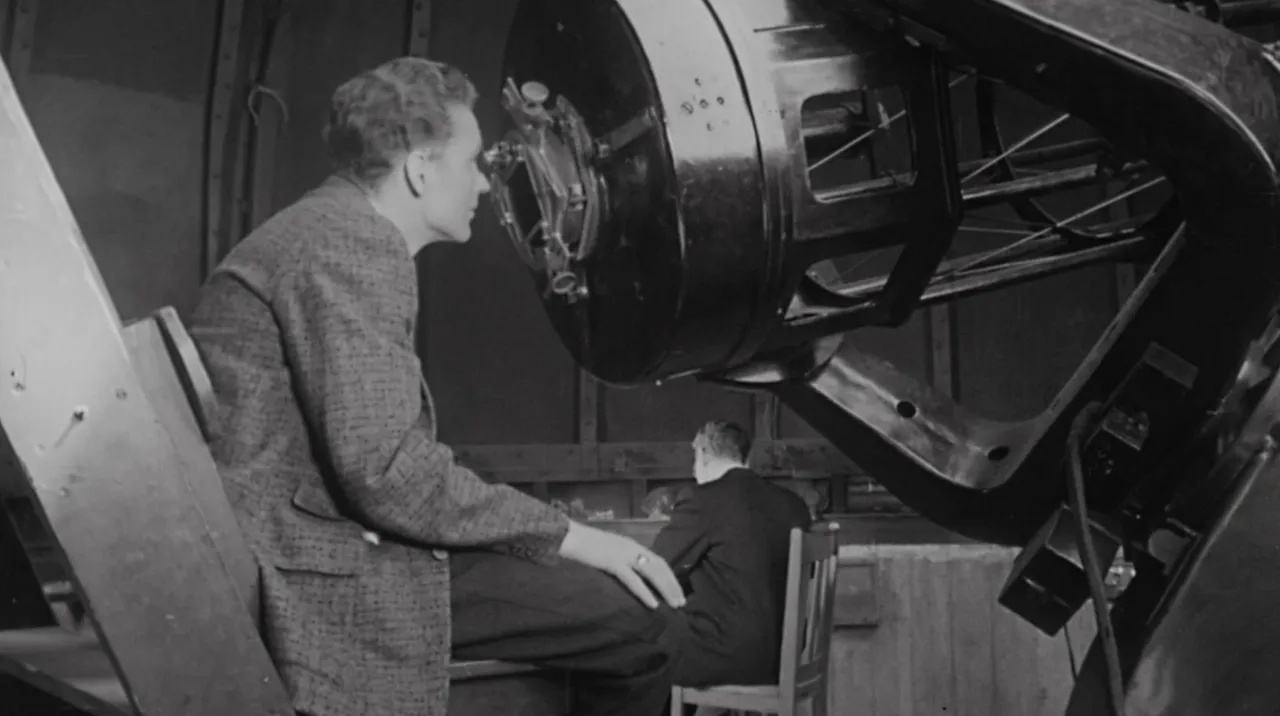
The director was W. Lee Wilder, the older brother of Billy Wilder, who made Sunset Boulevard and Some Like It Hot. Lee made low-budget crime and science fiction films instead. Variety called this one a "seemingly hurry-up production job". The chase ends inside Griffith Observatory in Los Angeles, and the location does a lot of the work.
Phantom from Space
W. Lee Wilder · 1953 · 75 min
1984 (1953)
George Orwell published Nineteen Eighty-Four, his novel about a state ruled by Big Brother, in 1949. Four years later, on September 21, 1953, CBS's Studio One broadcast it as a television play just under 50 minutes long. Critics count it as the first screen adaptation of the novel. Eddie Albert, later of the sitcom Green Acres, plays Winston Smith. Lorne Greene, later Ben Cartwright on Bonanza, plays O'Brien. Robert Culp, the future star of I Spy, is the voice on the telescreen.
It aired at the height of McCarthyism, the anti-communist hunt in American public life, and the critic Paul Mavis suggests the director Paul Nickell may have had it on his mind. Nickell built the state from lighting and bare abstract sets. Time called the hour bleak and humorless, but "television at its best". It survives as a kinescope, a film recorded off a TV screen.
1984
Paul Nickell · 1953 · 50 min
Devil Girl from Mars (1954)
Critics have placed this as Britain's copy of the American flying saucer film. It began as a stage play, and it shows: nearly all of it is set in one Highland inn. Nyah, a Martian in a black leather-look costume, lands in Scotland to take Earth men home, since women on Mars won a war of the sexes and their men grew feeble. Patricia Laffan, who played Nero's wife in Quo Vadis (1951), plays her. Her robot, Chani, is a lumbering machine that the review site The Movie Waffler calls a cheap knockoff of the robot in The Day the Earth Stood Still.
It was rushed into production to use paid-for studio time left over when another production by the Danziger brothers, British producers of fast, low-budget films, wrapped early. Leonard Maltin, the critic, called it a British imitation of U.S. cheapies. Octavia E. Butler saw it at about 12 and said it changed her life: she was sure she could write a better story, and a year later she was sending stories to magazines.
Devil Girl from Mars
David MacDonald · 1954 · 77 min
Killers From Space (1954)
Peter Graves, later the leader of the team on TV's Mission: Impossible, plays an atomic scientist who crashes while monitoring an atomic bomb test at a site called Soledad Flats. He comes back with no memory and a scar on his chest. His story: aliens living in caves under the test site revived him, and they soak up the energy of every atomic blast to breed giant insects and lizards and wipe out humanity.
W. Lee Wilder directed this one too. The giant creatures are enlarged shots of real lizards and insects, and the aliens' huge eyes are usually described as halved ping-pong balls, though the makeup artist Harry Thomas said he cut them from a plastic egg tray. The FBI hounds the hero as a possible impostor, and critics have read the mind-controlling aliens as a stand-in for communists.
 Horror
Killers From Space
W. Lee Wilder · 1954 · 70 min
The 27th Day (1957)
An alien whose sun is about to explode abducts 5 people: an American reporter, an English woman, a German physicist, a Chinese peasant and a Soviet soldier. Each gets capsules that can wipe out human life across a huge area and leave everything else standing. The capsules go inert after 27 days. Once the secret is out, governments hunt all 5, and the Soviets interrogate their soldier until he gives his up.
John Mantley, later a producer of Gunsmoke, adapted it from his own 1956 novel. The director, William Asher, had directed most of I Love Lucy and later made Bewitched, and Gene Barry, the star of The War of the Worlds (1953), leads. The ending turns the capsules into a weapon that kills only "enemies of freedom", which critics have read as Cold War propaganda. TCM writes that it is completely infused with the political mood of its time.
The 27th Day
William Asher · 1957 · 75 min
Space Master X-7 (1958)
A space probe comes back carrying a fungus that turns into a spreading growth called "blood rust" when it touches human blood, and a woman spreads it by touch without knowing. The poster promised "Satellite terror strikes the Earth," and the film was rushed into production to cash in on Explorer 1, the first American satellite, launched in January 1958, months after the Soviet Sputnik. It plays less like a space film than a contagion chase.
The director, Edward Bernds, had made Three Stooges shorts at Columbia, and he cast Moe Howard, the leader of the Stooges, in a straight role as a cab driver who gives the infected woman a ride. The budget depends on who tells it: Bernds said $90,000, and the producer Bernard Glasser recalled $125,000.
Space Master X-7
Edward Bernds · 1958 · 71 min
Teenagers from Outer Space (1959)
Tom Graeff wrote, directed, produced, shot and edited this film, did the special effects and acted in it as a reporter. Most accounts put the budget at $14,000. He shot it in and around Hollywood, at Bronson Canyon, Griffith Park and Hollywood High School. A young alien falls for an Earth girl and turns on his own crew, who plan to raise giant monsters on Earth as food.
The monster, the Gargon, is a superimposed silhouette of a lobster. The ray guns that turn victims to skeletons were dime-store toys. Warner Bros. still released it in June 1959, on a double bill with Gigantis the Fire Monster, and in 1992 it reached a new audience on Mystery Science Theater 3000, the TV comedy series in which hosts mock old low-budget films. Graeff never made another feature.
 Sci-Fi
Teenagers from Outer Space
Tom Graeff · 1959 · 85 min