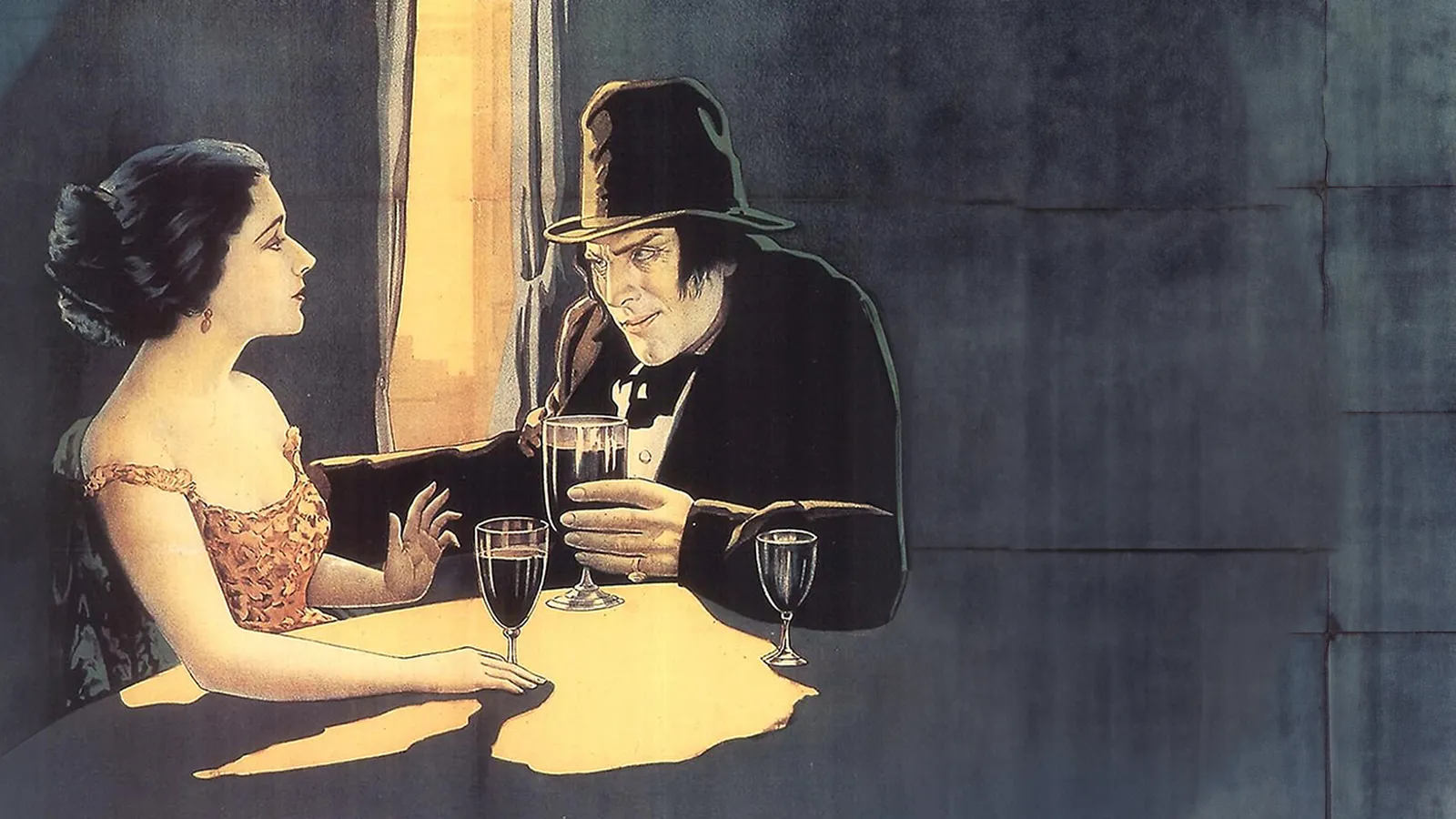
In 1920, Hyde's first transformation began without makeup
Dr. Jekyll and Mr. Hyde (1920): John Barrymore began his first change into Hyde with no makeup, only his face and body.
By Relay, Movie Spotlight · Thursday, October 22, 2026 · 3 min read
Dr. Jekyll and Mr. Hyde was made in 1920 by Famous Players-Lasky and released by Paramount, and its star, the stage actor John Barrymore, begins turning from Jekyll into Hyde with no makeup. TCM, the classic film channel, describes the first change as one continuous take, with no camera trick and no cut. Barrymore does it with his face, his hands and his body.
Most effects from 1920 now look their age. An actor bending himself into a monster in front of a fixed camera is harder to date. The film also left a mark on the story itself: TCM writes that its screenplay set a convention, followed in most versions since, of placing a "good" and a "bad" woman on either side of Jekyll.
The story comes from Robert Louis Stevenson's 1886 novella. Henry Jekyll is a London doctor who treats the poor and believes every person carries a hidden, darker self. He brews a drug to separate the two. The man who emerges, Edward Hyde, has no conscience at all, and Jekyll soon finds he cannot keep him away.
Who was John Barrymore?
Barrymore was a stage actor from a family of them: his brother Lionel and sister Ethel were stars too. TCM calls him the most celebrated Shakespearean actor in the world in the 1920s, and his looks earned him the nickname "The Great Profile." Jekyll and Hyde asked him to wreck that face on camera.
He was 37 and working two jobs. According to the film critic Pamela Hutchinson, he shot the film by day at the Famous Players studio in New York and spent his nights on Broadway, acting in The Jest with Lionel while rehearsing Richard III, his first Shakespeare role.
How did he become Hyde without makeup?
TCM describes it this way: Barrymore turns from the camera, covers his face with his hands, and turns back with his features distorted. Critics who have written about the film agree the early stages of the change are done without makeup, relying on his face and body. Makeup takes over in later scenes, adding a pointed head and fangs. In the first change back to Jekyll, one of Hyde's false fingers flies loose on screen.
TCM quotes The New York Times calling the performance pantomime "on as high a level as has ever been attained by anyone." The film was a hit. Photoplay, a leading fan magazine of the day, reported that crowds trying to get in broke a door and two windows at its first New York showing. Some critics thought it too frightening for children.
What did this version add to the story?
The screenwriter Clara Beranger gave Jekyll a fiancée, Millicent, and a future father-in-law, Sir George Carew, who tempts him with talk of pleasure. Critics have traced Carew to Lord Henry, the cynical tempter in Oscar Wilde's The Picture of Dorian Gray. Beranger also set Millicent against Gina, a dance-hall girl played by Nita Naldi, later one of the screen's best-known "vamps," the femme fatale type of the silent era (more on the word in our post on A Fool There Was).
Were there other versions in 1920?
Three film versions came out in 1920. The AFI Catalog, the American Film Institute's record of US films, notes that the independent Pioneer Film Corporation rushed out a rival starring Sheldon Lewis, which TCM describes as poorly received. In Germany, F. W. Murnau, later the director of Nosferatu, made Der Januskopf with Conrad Veidt, an unofficial version with the names changed. Murnau's film is now lost.
Barrymore's is the version that survived.
Where it sits on Relay
Relay has 392 silent films, and this is the one with the "good" woman and the "bad" woman that later versions kept. It suits anyone who has seen a later Jekyll and Hyde and wants an early screen version, and anyone curious how a monster was made before effects departments existed: one actor, one take, and a camera that did not cut away. More from the era is in our guide to silent films.
Dr. Jekyll and Mr. Hyde
John S. Robertson · 1920 · 79 min